
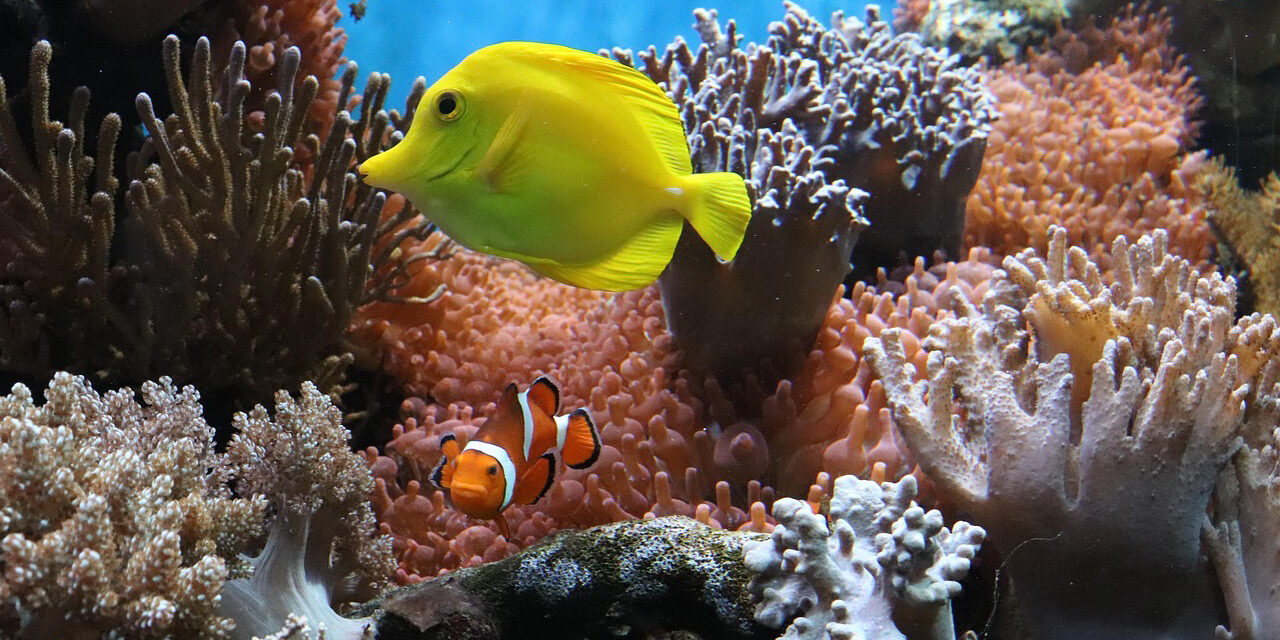
My wife and I are in Florida for vacation. This is pre 9-11, so maybe ’99 or ’00. We choose Florida, as my wife finds a cheap flight to Fort Lauderdale on the ginormous Gateway computer that occupies the half of our bedroom not occupied by the bed. This new “internet” is to us a marvel of ingenuity. It is a toddler still, and is not yet the painfully self-aware hate-and-deceit-spewing creature it will become as an early teen in another decade or so.
As my wife and I hope to explore the “Florida Keys” on our adventure, we purchase and pack swim fins and snorkels and diving masks. We hope to see—live and in spectacular technicolor—the outrageously bright and beautiful coral reefs and accompanying fauna we see on National Geographic and PBS specials. These programs we avail ourselves of via “television”—a now-elderly and feeble but once-vigorous provider of FREE broadcast information and entertainment, which by the end of the 20th century is barely clinging to life through the breathing/feeding tubes of something called “cable,” for which we are charged money.
So my wife and I are in Florida and treating ourselves to colorful drinks served in souvenir monkey skulls, marveling at jugglers of tiki torches, and comparing the lobster bisque (me) and the clam chowder (she) at each restaurant we patronize. We rent a car to ease the seeking out of all this fun, including our much-anticipated coral adventure.
This rental car we drive to a “Key,” secure in the knowledge that with our fins and snorkels and masks we are prepared to befriend personable octopi, avoid ominously lurking moray eels, and make memories that will render David Attenborough superfluous. Toward that end, in a “dive store” we discover—wonder of wonders—cameras both waterproof and disposable. These extraordinary devices are—as we later find—for tourist chumps such as ourselves to purchase for the taking of murky, waterproof, disposable photos. We book a reef excursion and step aboard a boat.
The sunny sky—and this will be important in a moment—is clouded over by the time our boat reaches the bit of reef over which we and our fellow snorkelers will soon be bobbing. We slip on our fins, affix our snorkels, and don our masks. We wrap around ourselves thick foam belts which—operating as our flotation devices—will remain on the surface while the fleshy nubs of our heads and limbs hang beneath to paddle around and see sights that will blaze themselves into the fixed frieze of dazzling images carved into our memories by previous vacations.
Unfortunately, the skipper of our vessel apparently does not see the many documentaries and films I see, and does not understand part of the adventure is to sit on the side of the boat and fall dramatically backward into the inky blackness. This skipper insists we remove the fins we have with great foreknowledge already donned, climb down a ladder that seems not so much a ladder as some sort of geriatric bathroom aid, and ease into the water. There, we are to re-affix the fins while allowing the belt to buoy us. This is awkward enough, but even more so with rubber foam belts shoved buoyantly into our armpits. The process strips all sleek dignity from the proceeding.
Even more disappointing, though, is the reef itself. Little do we know that without the sun to reflect them, the glorious colors we expect to see remain where they are—affixed to the flora and fauna. With no sensational colors to dazzle our eyes and shock our curiosity into paying attention, the long shot—Crushing Disappointment—is soon putting length upon length between itself and the pre-race favorite, Great Anticipation.
We see nothing but gray, like the gray of the hot and slightly urine-smelling New York City sidewalks we have only just fled. Many, many fish—no doubt blazing with unique colors when lit by the sun—flit by, sullen and undistinguished in their grayness. Spiky urchins on the gray sand floor take on the sinister look of lead-colored medieval spiked maces discarded after battle.
After forty-five minutes of our allotted sixty minutes of bobbing time, the skipper blasts his air horn. We in the water now know we have maybe fifteen minutes left, and are best advised to begin now the slow, sad paddle back to the boat.
And then… A SPLASH OF COLOR! Oh my GOSH! I cannot BELIEVE it! It is far away, but definitely orange and definitely blue and definitely bright! I swat excitedly at my wife, who bobs only a foot away. We pop our heads above the surface to communicate. We duck under again, and my powerful strokes guide us valiantly toward our goal.
The orange and blue shine like a beacon, but the water is choppy and in spite of my valiant stroking the colors draw nearer only slowly. I get there first, as my wife is tiny and buffeted by the chop. Am I concerned? Not so much, as the treasure is just below me. I position myself over the colors and peer down. The colors are maybe 7 or 8 feet below me and seem incandescent. Through the murk I can see… spelled… something? Words? What?
I dive, but the white foam flotation belt keeps me from reaching the thing. I dive again. And again. Now my wife joins me. I babble to her that the colorful thing has WORDS on it, and slip out of my flotation belt. My wife is instantly irate and comments unhelpfully that without the protective buoyance of my flotation belt I may well be dashed against the coral and ground to paste, and that even if I do not, the skipper may very well leave without us in any case. We must paddle back now, she says with great urgency while gesticulating wildly.
But I have to see. I must know.
I dive straight down. I grab the thing. I bring it back up. We pop our heads out of the water and up go our masks. I hold the thing out. It is smooth and plastic and rectangular and reads “AVIS” in white letters on a blue background surrounded by an orange border. It is a key ring. And there is a key on it.
My wife blows out a puff of watery spray and asks, “Jonathan, what did you do with our car key?”
It is the key to our rental car. My new swim trunks sport a mesh inner pocket & flap designed specifically to keep objects safe inside while one is swimming. Despite the skipper’s insistence that all possessions be left for the duration of our bobbing in the bags kindly provided each party of snorkelers, I decide the car key is far too valuable to entrust to any potential thieves among the crew. I tuck it inside my specially designed mesh pocket, which fails in most spectacular fashion to keep the key safe.
We swim back to the boat, my wife and I, remove our fins, and climb up the geriatric bathtub aid. We sit and dry ourselves as it is chilly, the sky being gray with clouds. We start to put on our clothes. My wife makes me show the key again, as I have just proven I might allow its escape at any time.
I show her the key.
“If you had lost that key,” she says, “you’d be WALKING back to New York.”
This is one of a hundred stories I can tell about times this tiny person who married me was right and I was wrong. But here is the thing that stupefies me to this day.
We are on that reef for almost an hour. We paddle over maybe 1,000 square yards of reef and sandy bottom. There is no telling when the key drops out, but when I spot it, it is probably twenty-five murky yards away. I only catch a glimpse of it by the merest chance. What odds? If the odds of a long shot to finish in the money are the same, I do not bet this long shot.
The blobby murk of the reef that day is nothing I or my wife wish to see. We wish to see sights worthy of National Geographic and PBS. But on the other hand, if the reef is alive in sun-drenched and reflected color that day, I never in a thousand years catch sight of that Avis rental car keychain. And then I will have to walk from Fort Lauderdale to New York City on foot, probably ending up as a dried husk at a highway rest stop, surviving on bathroom tap water and Lance’s cheese crackers from the vending machine until I run out of coins and expire.
That single splash of color saves my life.
[Image by Pixabay.]








Recent Comments