
A Case for Fair Treatment
It is maybe ’81 or ’82 and I am back in my old Kentucky home from college for the summer. Behind a desk in the lobby of the First National Bank in this town works a chatty lady who—by virtue of this chattiness—discovers every tiny iota of this and that in the way of rumor and gossip. By way of metaphor, she is not entirely unlike a kindly spider with red lipstick, detecting from the center of her web each shudder and tremor of the strands that weave themselves through the entirety of our town of 8,700 souls.
This lady is also my mother.
Among the tremors she detects just recently is a need on the part of a local farmer—whom I shall refer to hereafter as “Old So and So,” in order to stay on his good side, should he still harbor ill will in the hereafter—to hire “farmhands.” This tremor my mother conveys to me, along with the information that she has already taken it upon herself to secure for me one of these positions.
This is news to me, but not entirely unwelcome. The local fish and cheap eatery which provided my whopping $3.25-per-hour wage during my high school years is fully staffed for the summer. As I am 18 years old and full of vigor but mostly ignorance, I leap at the opportunity.
This is a fine time to mention that working as a farmhand in tobacco and corn and hay in Kentucky in 1981 or ’82 is not a job for a “townie” such as myself to take lightly. My high school friend Hugh is a “farm kid,” and from the age of thirteen has an effortless handshake like a sandblasted granite vise, with forearms banded in muscle worthy of the statue of David. This observation, however, has not yet fully penetrated my thinking, as I am young and stupid.
At the appointed hour of the appointed first day, “Old So and So”—with himself as the driver—appears in front of my house, and I leap into the back of a rumbling pickup truck. There I encounter a fellow I know a bit already.
He looks calm in his green ball cap with a yellow bill, long red hair streaming out from beneath it. His name is Dwayne. He is a year my senior, and only a few years earlier is known in our baseball league as the possessor of a fastball that elicits pleas from young batsmen such as, “Please, Coach, do not put me in the lineup today.” Fortunately for most of that time, I play on the same team as Dwayne—though this makes little difference, as I never in my athletic career see a thrown baseball at which I cannot not swing and miss.
Sadly, as it turns out, Dwayne and I—upon arrival at the farm—are placed by “Old So and So” on the same work team.
Such a job I never had before or since, with perhaps the sole exception of carrying block and brick and “mud” through sopping wet blankets of ninety-percent humidity (called “air” in the Ohio Valley) during a summer of ninety-five-degree days when I am fourteen years old. But now, four years later, Dwayne and I—townies to the marrow of our bones—find ourselves, in senses both figurative and literal, light-years from our soft suburban existences. Of typewriters and due dates for written essays there are none. Of spine-twisting, hand-macerating, aorta-popping, skin-abrading manual labor, there is no end.
Weeks into the job, on the day of what will later be called “the incident,” Dwayne and I—though hardened and sun-cracked leather compared to the college boys we are on day one—remain the soft underbelly of a work team loading hay. The other four members of this detail are farm kids.
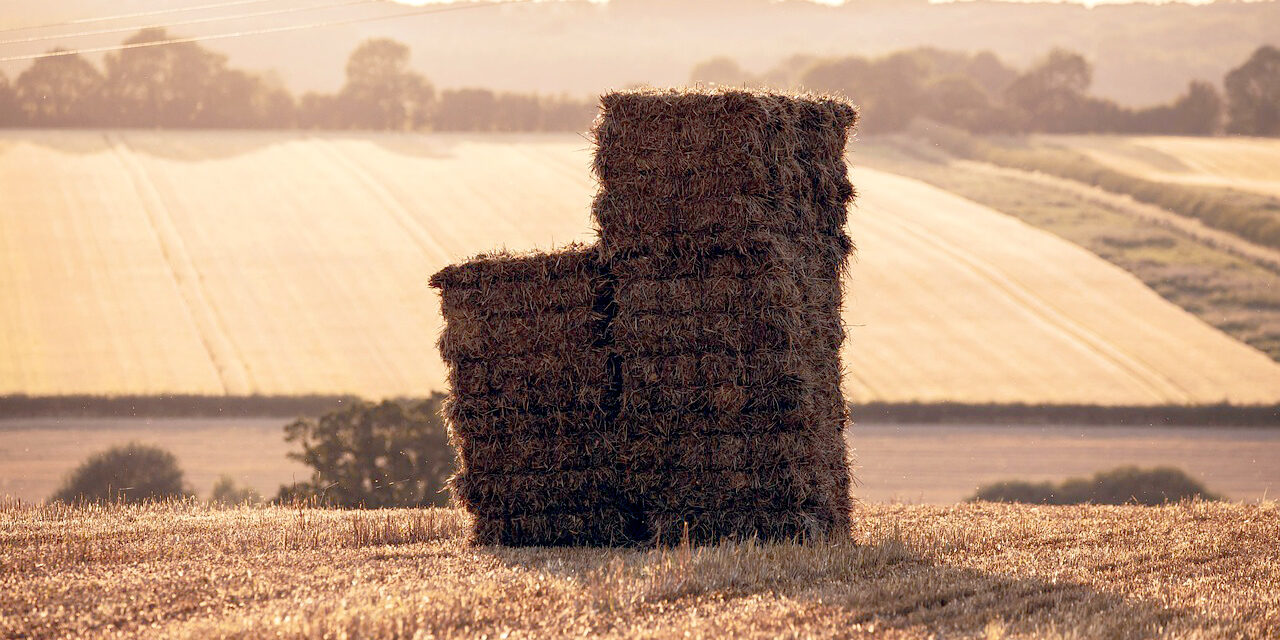
These farm kids are inexhaustible and incapable of complaint, their slim bodies apparently composed of some kind of cable. They fling hay bales effortlessly and tirelessly for hours, tossing bale after bale onto a flatbed truck, where the bales are “ricked” together like puzzle pieces into a self-supporting structure. The loaded truck then rumbles to the barn, where the farm kids drop us off with barely audible but unmistakable derisive sighs of relief.
It is here that Dwayne and I are assigned to unload the wagon into the upper story of the barn and re-rick it in a corner beside the bales ricked the previous day by workers most emphatically not us. We swell with self-importance at having been selected. We after all, do this chore before—though not the day previous, which will become important shortly.
We hoist the first bales from the flatbed and are instantly struck by the fact that the hoist sufficient for casting a bale onto a four-foot-high truck bed is no longer sufficient for casting that same bale six feet higher into a loft. Without the inspiration of our farm-kid coworkers, our college-boy brains take over. Better, we decide, to climb the wooden steps and inspect the situation first—taking full advantage of every fractional possibility that the earth will crack open and swallow the farm, rendering further labor unnecessary.
The earth does not oblige. With each step upward the temperature rises until we emerge into the loft at what must be roughly 270 degrees Fahrenheit, where we behold our future for the next three hours.
The hay ricked the previous day—again, most emphatically not us—has slumped sideways like a drunken sophomore on a sofa. The structure is a collapsed mess. Bales lie scattered like discarded corpses or lean against one another in the soggy heat like exhausted heavyweights in the fifteenth round.
Before us lie hours of pulling and shoving, hoisting and re-ricking yesterday’s work.
Perhaps ninety minutes pass. We are slick with sweat, caked with grime, breathing out not carbon dioxide so much as hay-husk dust from which every atom of oxygen has been stripped. When we hear the rumble of a truck our hearts leap; lunchtime must be close. But what we hear is not the gentle closing of a door so much as an explosion of sound, accompanied by a stream of invective so fierce we are momentarily paralyzed.
These vulgarities are directed at us.
The throat from which they issue belongs to “Old So and So.”
Terrified beyond belief, we scramble from loft to bales to flatbed to ground, where “Old So and So” lashes into us, apoplectic with rage that the flatbed has not been emptied. We attempt to explain ourselves, but his face burns the orange of a cigar end and he will hear nothing. When he finishes dressing us down, he roars away, calling out that we will get the flatbed unloaded lickety-split—right after lunch.
Lunch is thirty minutes. We eat quickly and taste nothing but fear. We agree we will make our case. We will explain that the previous day’s ricking—performed by workers most emphatically not us—must be corrected before any new hay can be properly stacked. Surely he will understand. “You say it better,” Dwayne tells me. “You take the lead.”
When lunchtime ends, “Old So and So” returns, bursting from the truck already gesturing toward the hay. I step forward, which is to say I stand rigid and terrified. I explain our reasoning. I make point after salient point. I conclude with the faintest mention that the way we are spoken to before lunch is not fair.
His face cycles through orange, red, purple, to black. He opens his mouth and unleashes such filth and fury that the leaves of the tree under which we stand seem to curl back into their branches. Dwayne stands silent, yellow bill pulled low. I am screamed at with such ferocity that the clouds retreat and the sky blazes.
Then I am walking.
I am walking back “to the house” to call my father to come pick me up, because I have been fired.
Some weeks later, shortly before returning to college, I am mowing the lawn when Dwayne pulls his rusty purple beater to the edge of our yard. He removes his cap as he gets out, which I take as a sign of peace.
“Sorry, J. My bad,” he says. “I was gonna say something but…”
He doesn’t finish the thought. I wave off the apology. We make small talk—about farm kids, maybe baseball, the coming school year. His visit is brief. The car belches black smoke and he drives away.
Dwayne and I never speak again.
But he comes that day. He shows up. He demonstrates an integrity many others I encounter in the ensuing forty-five years—including myself, on more occasions than I care to admit—fail to demonstrate. Apologies are difficult enough without tracking someone down to offer one.
I sometimes wonder how he would have finished that sentence.
“I was gonna say something but…”
It doesn’t really matter. He shows up. And that is more than many can manage.








As The daughter of another old so and so, I can tell you, my dad put all the young hay hauler guys through a sort of boot camp. If they were deemed worthy, they were asked to come to help again. My mom would cook a big meal for them. My sister’s and I all married a hay hauler. We laugh about this now. So much has changed since the days of square bales.
Great name for an essay! “I Married a Hay Hauler”.