
My favorite Tom Petty song is “I Won’t Back Down,” which I’ve always thought of as the unofficial anthem of Southern bull-headed stubbornness. Living in the South, it’s an attitude I frequently see up close and personal and, if I’m honest, display more than a few times myself.
That spirit has kept generations of farmers plowing after years of drought or rebuilding in valleys that flood every decade. It has also inspired people to fly the flag of the losing side of the Civil War and call it Southern pride — a peculiar Southern talent of refusing to admit defeat while simultaneously building an identity around it.
As Tom Petty tells it, it’s the willingness not to back down, even if someone stands you at the gates of hell. That stubborn streak isn’t always noble. Sometimes it’s petty. Sometimes it’s hilarious. Especially when it whups the ass of reason.
For instance, I once lived up the street from a man who installed a billboard-sized sign in his front yard and regularly hand-painted diatribes against the Knox County Sheriff’s Department, switching to a new gripe every few months. In a world before social media, this was the most effective way he could come up with to get his opinion out. A member of my own family, after being sold a lemon by a car dealership, wrote messages on the car about the bad deal, then spent hours driving it up and down in front of the dealership. Most Southerners can name at least one person who turned indignation into this kind of performance art.
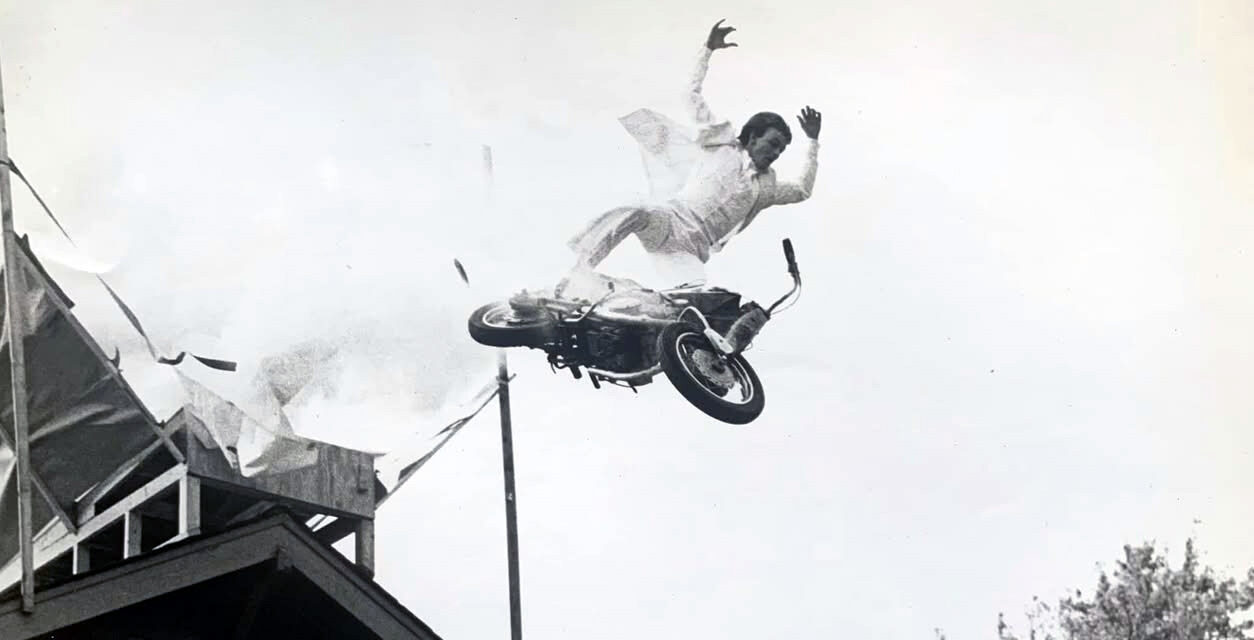
But my favorite example involves a man in a white tuxedo riding a motorcycle off the roof of a beer bar across from a small Southern Baptist college during Homecoming.
I know about this because I was there.
In October 1981, I was a sophomore theatre major at Carson-Newman College (now Carson-Newman University) in Jefferson City, Tennessee. It was, and is, a small Southern Baptist liberal arts institution about forty-five minutes east of the University of Tennessee. You could get a respectable, Christian education there without being too concerned about constant exposure to alcohol, debauchery, or moral collapse we were warned about in Tuesday morning chapel. Those who craved more danger and excitement no doubt leaned toward the liberal side of Baptist doctrine and simply drove to Knoxville on Friday nights — with Satan riding shotgun.
Weekends in Jefferson City during the early ’80s weren’t known for offering a long list of temptations or dining options. Geno’s Pizza was always packed with both locals and college students. Bell’s served dependable country fare. And for the late-night heathens, there was Pop’s Place, a truck stop-style greasy-spoon where you could play pool and smoke cigarettes way past midnight. It was the kind of place that required burning your clothes afterward unless you wanted your classrooms fumigated the following week.
So when a small bungalow across from the men’s dorms was suddenly lit up at night and painted bright orange and blue — the school colors — it immediately caught our attention. It looked, at first glance, like a new official college hangout. A coffeehouse, maybe.
It wasn’t.
The house sat on property owned by a local antiques dealer named John Coker. By all accounts, Coker was a decent and honest man. He wanted to sell his parcel to the college. The college wanted it too, just not for the price Coker had in mind. According to friends closer to the land negotiations than I, Carson-Newman brought in outside real estate agents to reassess the property value downward, which angered Coker. Then, somewhere in the middle of stalled talks and wounded pride, Coker received a parking ticket from campus security.
It was, perhaps, bad timing to issue a parking ticket.
Instead of filing paperwork or writing letters, Coker chose to escalate. As former art professor Bill Houston describes it, Coker “declared war in the Groucho Marx style.” If he couldn’t sell the property on his terms, he would make the property impossible to ignore.
He opened a private club and named it The Mad Ox, a playful “tribute” to Carson-Newman’s then-president, Dr. Cordell Maddox. He painted the building in school colors, and floated the idea of turning the club into a biker bar. His most infamous idea — the one intended as a huge middle finger to the college — was to schedule the grand opening to coincide with CNC Homecoming.
That’s when he hired a daredevil stuntman.
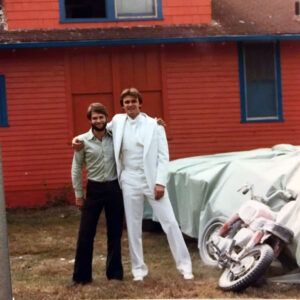 The stuntman was Ron Broyles, known locally as “Crazy Ron,” who worked frequently with Knoxville furniture salesman and publicity impresario Mad Jack Fielden. At the time, Broyles was developing a national reputation for doing things most people would not consider wise life decisions: climbing giant skyscrapers, courting arrest and jail time, and wearing formal attire while doing so.
According to Broyles, for the opening of The Mad Ox, Coker encouraged the stunt crew to “do pretty much anything we wanted.” They suggested riding a motorcycle off the roof. Coker agreed.
Bill Houston remembers a couple of his art friends moonlighting for extra cash and helping build the runway and launch ramp. Houston preferred to stay far away from the planning, fearing the wrath of President Maddox and the possibility of losing his position or causing retaliation to the Art Department.
On the morning of October 17, 1981, in the middle of Homecoming festivities, a rowdy crowd gathered. Alumni in orange-and-blue ties and decorative chrysanthemums mingled with gawking students like me, all of us trying to figure out what the spectacle was about. Smoke from a barbecue grill drifted through the air, and the constant revving of a motorcycle engine made it all impossible to ignore.
The Morristown Citizen Tribune reported there would be free barbecue and beer — four kegs’ worth. Across the lawn, Carson-Newman security officers were reportedly taking down the names of students spotted holding free drinks.
And across from the small, quiet Southern Baptist college — celebrating a tradition of solid Christian education and fellowship — a tall, lanky man in a stark white tuxedo straddled a motorcycle atop a 25-foot roof.
The bike had been manhandled up there with the help of eager onlookers and, quite possibly, the devil himself. The landing pad below consisted of cardboard boxes covered with a tarp. For effect, Broyles had rigged an explosive squib on the bike to detonate as he left the ramp, because subtlety was never part of the plan.
The bike engine roared. It accelerated down the makeshift runway without even a test run. The squib popped as Broyles cleared the ramp. For a few suspended seconds, a white-clad figure hovered in the East Tennessee sky like a celestial angel conducting a flyover of Carson-Newman College.
With characteristic understatement, Broyles says he hit the landing pad “pretty close to the desired location.” There was, in the end, no divine intervention. No spontaneous revival. Just scattered applause, dust and debris, and a fledgling bar that suddenly had a reputation — along with the undivided attention of college administration and a lawn full of Baptists.
Not surprisingly, The Mad Ox didn’t become the biker stronghold Coker may have envisioned. It remained open only a few more months before finally fizzling out. I never knew a student to set foot inside. I suspect Coker didn’t expect it to last. His point had already been made.
Years later, Carson-Newman acquired the property from whoever owned it at the time. The little bungalow was demolished into orange-and-blue rubble, and in its place now stands a fancy, polished academic building — one that, fittingly, houses the drama department.
History, however, remembers.
The stuntman remembers. I remember. Professors and alumni remember. And in the lobby of that new building hang framed photographs of a white-tuxedoed man flying off a roof like a small-town Evel Knievel — undeniable proof that for one Saturday in 1981, Southern stubbornness briefly outran decorum.
East Tennessee has long been considered scrappy. During the 1982 World’s Fair, a New York publication labeled Knoxville “a scrappy little city.” It was meant as a subtle insult, but Knoxville embraced it as a motto — because it is true. Scrappy is what we are. We don’t always win. We may not always be right, but we won’t back down easily either.
Sometimes that spirit builds universities. Sometimes it splits atoms in Oak Ridge. And sometimes it builds a ramp on a bar roof and launches a motorcycle at 11:30 in the morning just to prove a point.
All over a parking ticket.

[Photos courtesy of Ron Broyles]

Like this story? Support this writer:





Recent Comments