
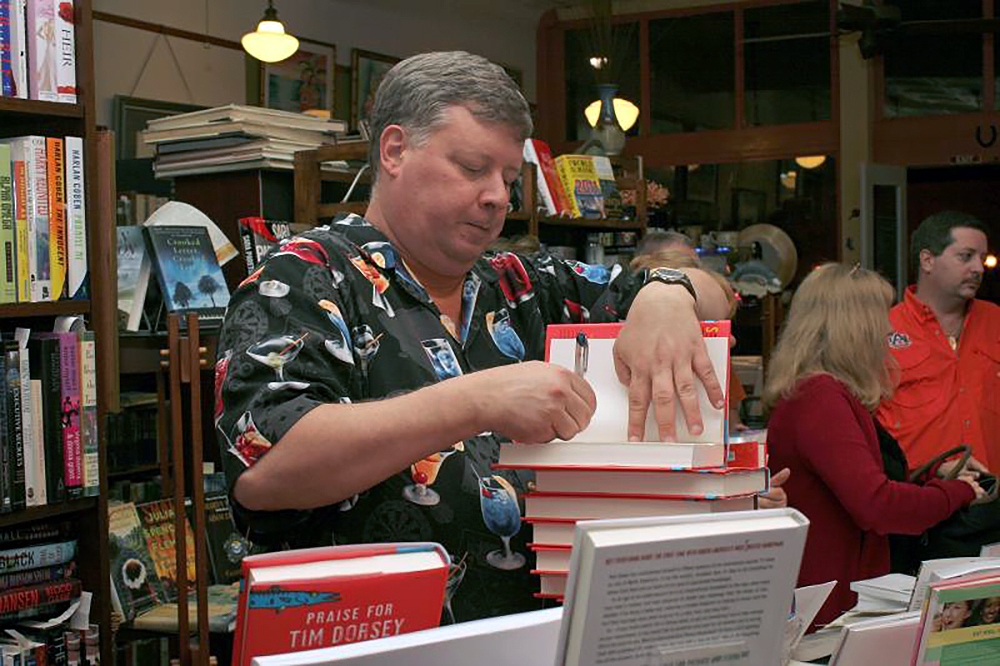
Tim Dorsey signing books at Muse Books, DeLand, FL 2011
Last October, my wife and I went to Naples, Florida, to celebrate our tenth anniversary. It was the usual Florida script — sun, sand, retirees moving at half the speed of a sea tortoise. At some point I decided I needed something to help me unwind in the damp autumn heat, so I picked up a book at the nearest Goodwill, mostly because the cover promised unorthodox mayhem: No Sunscreen for the Dead by Tim Dorsey.
I’m not much of a fiction reader, and I’d never heard of Dorsey, but I was willing to take a chance. For one thing, I’m the kind of fluorescent white guy for whom sunscreen is non-negotiable — skip a layer and I’ll combust. A book with that title felt less like a novel and more like a survival manual.
What I got instead was one of the most insane, action-packed literary rides of my life.
Within a few chapters, it was clear this wasn’t just a funny crime novel. It was something more offbeat and ambitious — a full-tilt Florida odyssey running on manic energy, obscure state history, and a moral code that was somehow both deranged and weirdly principled. Naturally, right around the time I decided Dorsey would be perfect to interview for The Leghorn, I found out he had died in 2023. The timing felt like something out of his own fiction: darkly ironic, distinctly absurd.
The Beginning of the Storms
Over 26 novels, Dorsey built his literary universe around one of modern crime fiction’s most unforgettable characters: Serge Storms. Serge is a walking encyclopedia of Florida trivia, a hyper-verbal road trip enthusiast, and a self-appointed enforcer of justice. He is also, quite unapologetically, a serial killer — though strictly of people who exploit, scam, pollute, or prey on the vulnerable.
The concept shouldn’t work. A homicidal history buff dispensing elaborate punishment across the Sunshine State sounds like a parody of a parody. Yet in Dorsey’s hands, Serge becomes something more nuanced: a satirical instrument. Underneath the chaos lies consistency. Serge has rules. He protects retirees from scammers. He despises environmental destruction. He reveres forgotten landmarks. His violence is absurdly creative, but his outrage is specific and focused.
Beside him is Coleman, his permanently altered sidekick, who drifts through each novel in a chemical haze — offering snack breaks and occasional commentary while Serge monologues about citrus empires or Cold War missile sites. The contrast is part of the magic. Where Serge is explosive and encyclopedic, Coleman is sublimely horizontal.
Dorsey once suggested he wasn’t really writing crime novels at all. He was writing Florida novels, and crime just happened to be part of the climate. That distinction matters. Florida isn’t merely a setting in these books. It’s the central character.
A Literary Love Letter to the Sunshine State
Dorsey began this strange and wonderful project with Florida Roadkill in 1999. In early drafts, he considered killing Serge off. Thankfully, he reconsidered. For the next twenty-five years, he released nearly a novel a year, culminating with The Maltese Iguana — an ongoing, serialized commentary on Florida’s retirees, developers, strip malls, roadside attractions, con artists, and political absurdities.
The satire works because it’s rooted in genuine affection. Dorsey didn’t mock Florida from a safe distance. He adored its weirdness. He catalogued and preserved it. His novels are packed with real historical tidbits — forgotten tourist traps, strange land deals, bizarre headlines — delivered at breakneck speed through Serge’s manic enthusiasm. Reading one of his books often feels like being trapped in the passenger seat with the most knowledgeable and unstable tour guide in America.
In No Sunscreen for the Dead, retirees are being scammed in a Florida community, and Serge responds exactly as you’d expect — with elaborate vengeance and a crash course in local history. The novel shines not just for its absurdity, but because the outrage feels earned. Dorsey understood that beneath the jokes are real grievances: exploitation, greed, and the commodification of paradise.
What You’ll Experience in Any Serge Novel
Certain elements define the Dorsey experience regardless of which book you pick up. You’ll get a Florida history lecture whether you asked for one or not. You’ll encounter an outrageously inventive justice device that borders on avant-garde theater. The plot will spiral through diners, motels, Everglades backroads, and investment seminars with the logic of a Category 5 hurricane. Coleman will offer blissfully detached commentary. And beneath it all, a strange but consistent moral compass guides the chaos.
That moral center is what keeps the series from collapsing into nihilism. Serge may be unhinged, but he is not random.
For those who prefer audiobooks, Oliver Wyman narrates many of the Serge novels and is spectacular. He doesn’t merely read the text — he inhabits it. Serge’s manic pivots, the regional accents, the bursts of trivia, the explosive tonal swings. Wyman amplifies the comedy without flattening the characters. If Dorsey built the roller coaster, Wyman operates it at full throttle.
Why Read Dorsey Now?
Satire tied too tightly to headlines tends to age poorly. Dorsey’s work holds up because it’s anchored in character rather than momentary outrage. Serge Storms isn’t just a commentary on “Florida Man” culture — he’s a lens through which Dorsey examined American optimism, greed, nostalgia, and absurd civic pride.
Dorsey died at his home in Islamorada in November 2023, at age 62. He left behind 26 novels and a character who feels strangely immortal. When I picked up that book in Naples, I was just looking for something to pass the time. What I found was a writer who turned chaos into craft and Florida into mythological legend.
If you’ve never taken a road trip with Serge Storms, there’s an entire deranged, sun-drenched, gloriously educational universe waiting for you.
Sunscreen optional. Seatbelt recommended
Tim Dorsey Timeline: A Quarter Century of Florida Mayhem
1961
Born in Indiana; raised in Florida.
1980s–1990s
Works as a journalist, including at the Tampa Tribune, absorbing the state’s daily absurdity.
1999
Publishes Florida Roadkill, introducing Serge A. Storms.
2000–2018
Releases nearly one novel per year, building a cult following.
2019
Publishes No Sunscreen for the Dead, widely considered one of the strongest entries in the series.
January 2023
Releases The Maltese Iguana, the 26th Serge novel.
November 26, 2023
Dies in Islamorada, Florida, at age 62.
Legacy:
26 novels. One unforgettable antihero. Hundreds of pages of Florida history delivered at faster-than-your-average-golf-cart speeds.
[Photo by Quinn deEskimo via Wikimedia Commons (CC BY-SA 3.0).]

Like this story? Support this writer:


Recent Comments