by Mac McLeod
Chip Le Fevre was always a fool, the class clown.
One of the most often told stories about him was about an incident that happened at the Dog River Bridge, where the sluggish river meets the expansive Mobile Bay. Chip’s parents lived on the Dog River. In 1954, during the summer after his first year at college, Chip came home so drunk he left the car in the driveway. He was afraid he couldn’t get it in the garage without scraping the sides. The garage entrance seemed to have shrunk since he left. Stepping out of the car, he decided to take his family’s boat out for a run down the river to the Dog River Bridge and back. He thought the wind would sober him. Turns out he was wrong.
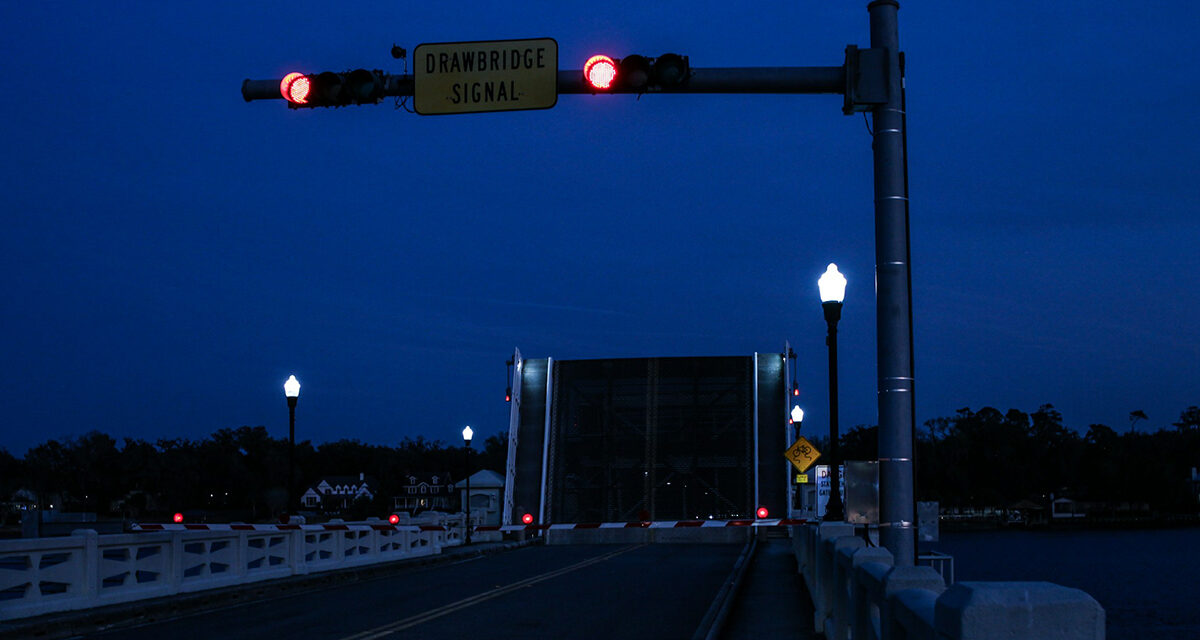
The boat was a restored Chris-Craft speedboat, originally built in the ’40s. Its decking was made of mahogany planks, with spotless white caulking. The pristine red leather seats would hold eight people comfortably. A magnificent chrome siren was mounted in the middle of the deck. It was about a three-mile trip. When Chip had the bridge in sight, he turned the siren up to its full shrieking volume. An obese man in the small office on the bridge, hearing the siren, thought a tall boat was coming down the river. He quickly lowered the barriers at each end of the bridge and the metal grid in the center parted and began the long climb toward the stars. The attendant looked up-river, but he couldn’t find the boat in the darkness. “Damn fool! No running lights,” he said to a small Chihuahua which he held delicately in the crook of his right arm. The dog seemed to nod its head in sardonic agreement. The man and dog continued to scan the river for the approaching boat. Chip had a bottle of Spearman’s Straight 8 Ale in his hand and stood on red leather, doing the “dirty bop” and singing. The boat was aimed at the exact center of the opened drawbridge, even though Chip’s hands were not on the wheel. Leisurely creaming through the water at twelve knots, the Chris-Craft was barely up on a plane.
At 12:37 a.m., Chip Le Fevre suddenly disappeared from the beautifully restored boat. He flew straight up into the hot thick summer air. A local Free Will Baptist preacher was night fishing nearby. He did not witness Chip’s departure. If he had seen it, he would have been certain the Great Tribulation had begun. Chip left the boat just as he began singing “Lucille” and imitating the raw, rasping screams of Little Richard. It was a surprisingly accurate performance. Still singing, he seemed to hover over the water as the boat sped out from under him.
Earlier that day, a construction crew from Southern Bell had been installing a thick cable across the river. It was to be attached to large metal towers on either side. Since they had not finished the job at sunset, the men temporarily secured the cable for the night. It turned out to be, it wasn’t secure enough.
By late that night, the heavy cable had sagged just enough so that it caught Chip under the chin as he cruised under it. His handsome face was spared because, at the moment he contacted the cable, he threw his head back and screamed “Lucille!” He held the note an incredibly long time, even after he was six feet under Dog River. A passing school of twelve mullet heard a high-pitched, gurgling “eeeeeeeel!” They instantly, and in formation, jumped out of the water on a precise heading of west. At the shift change, the drawbridge attendant reported a driverless boat passed under the bridge at 12:38 a.m. The boat was never seen again. There were soon rumors that the attendant was “a drinker.”
Chip swam ashore on his side, with one arm pumping spasmodically in the water. At the end of his other arm, he clutched a surviving bottle of beer. It looked like a small periscope observing Chip. He walked the three miles home and went straight to his room. The next morning, he told his parents he had a terrible sore throat. This was to explain why he wore turtleneck sweaters for the next three weeks and why he was so hoarse. Actually, the hoarseness enhanced his Little Richard imitation, which he used to great effect the next night as he told the story to some friends. His dad assumed the boat had been stolen. Chip told him he had not heard any suspicious noises the night before, even though he was “up late studying biology.”
A month later, because of a good insurance policy, they had an even better boat. That was when Chip decided to go into the insurance business. He wanted to be part of something that could “make things right in a world gone wrong.” Actually, he didn’t think in those kinds of altruistic terms, but he did use those words twenty years later when he was given a sales and service award by one of the companies he represented. He told the audience at the awards banquet that he had been converted to the insurance “bidness” when his dad’s beloved boat had been stolen in the ’50s and an insurance company had replaced it.
Chip never finished college. He was too busy raising hell to make grades. Now he has one of the most successful independent property and casualty agencies in Mobile and is senior warden of the vestry of Immanuel Episcopal Church, where he is the leader of the more conservative members. Chip still lives on the river. His parents dead, he is in their lovely old house with his tall blond wife and their three tall blond children.
Sitting in the boat shed is a restored 1941 Chris-Craft.

Mac McLeod is 89 and a brand-new 2026 poet and fiction writer. His work has appeared in Eunoia Review, Belladonna’s Garden Literary Magazine, The Disappointed Housewife, The Leghorn, and pending publication in several other Journals. Mac has had an eclectic life; a former Senior Military Aviator, Lawyer, and Episcopal priest. Support this writer.