by Charles J. Witt
By ten-thirty that morning, Margaret Bell had already decided the lantanas could wait another week. They had waited this long. She stood at the kitchen sink with both hands around a coffee cup and looked through the window above it. The flower bed stretched along the front of the house, from the porch steps to the corner beneath the bedroom window. Years ago, the lantanas had grown thick enough to hide most of the brick behind them. Yellow, orange, pink, red—Frank had planted every one.
Now half the branches were gray underneath, the tops had gone wild, and one plant leaned so far into the walkway that Margaret had to sidestep it every time she went for the mail. Frank would have hated that. He’d had opinions about everything that grew. Too much water. Not enough water. Wrong mulch. Wrong fertilizer. Wrong time of day. And heaven help anybody who suggested trimming something in July.
Margaret had spent thirty-eight years pretending not to listen to him explain plants. It was remarkable how much she missed hearing it. She took another sip of coffee and turned away from the window. Outside, somewhere down the street, music grew louder. Not bass. Not the rattling thump the teenager three houses down favored. Country music. Old country music.
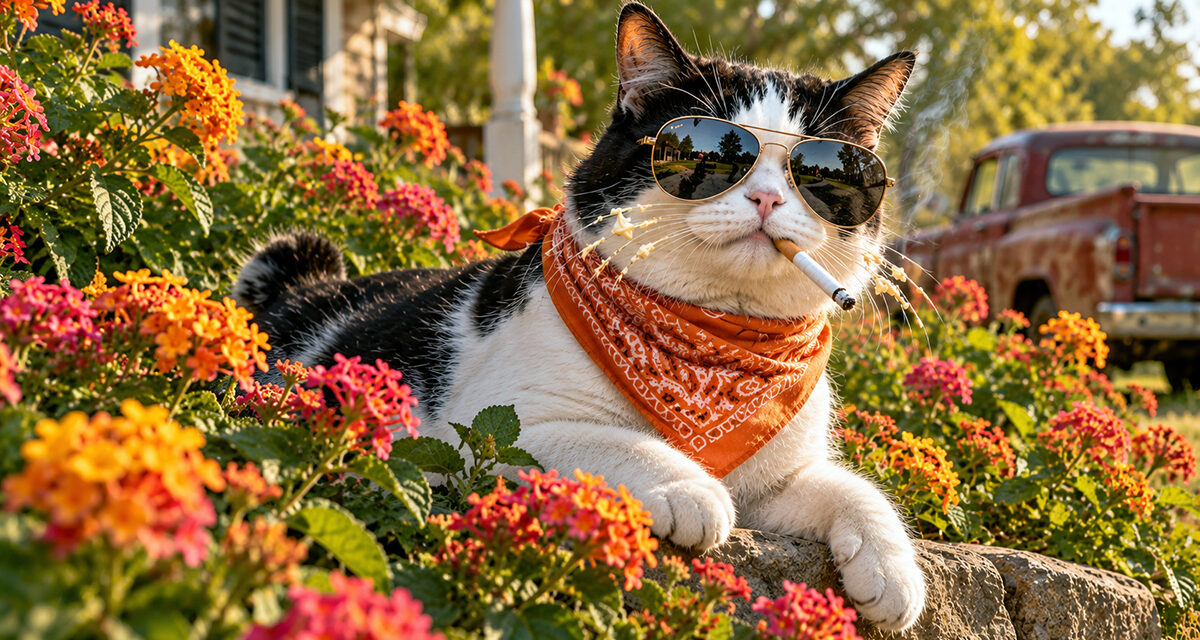
Margaret frowned and stepped back toward the window. A faded red Ford pickup rolled past the house at perhaps twenty-five miles an hour. The driver’s window was down, and Ronnie Milsap poured from the speakers loud enough to announce the truck a good half block before it arrived. The driver was a sight. A brown mullet rested against the collar of his faded camouflage T-shirt. Aviator sunglasses covered his eyes. A heavy mustache stretched across his upper lip, and an unlit Winston 100 hung from one corner of his mouth.
Beside him sat a black-and-white bobtail cat. The cat was also wearing aviators. Something white and narrow protruded from its mouth. Margaret moved closer to the glass.
“Is that a cigarette?”
The truck continued past. She watched it disappear beyond the edge of the window. Then the music stopped moving away. Brake lights glowed. The Ford stopped in the middle of the street. Margaret narrowed her eyes. The truck began backing up. Not turning around. Backing up. It reversed thirty yards down the road, Ronnie Milsap coming steadily closer again, until the truck stopped directly in front of Margaret’s driveway. The driver leaned across the steering wheel and looked toward her house.
Then toward the flower bed. Then back toward the house. He pointed at the lantanas. Margaret was still trying to decide what exactly she’d just witnessed when the Ford turned sharply and backed into her driveway. He reached through the open window, pulled the outside door handle, and stepped out in faded jeans and work boots. The Winston remained in place. The cat stayed in the passenger seat.
From the truck came, “There’s a stranger in my house.” A quick two-note instrumental sting followed. The man froze. His head tilted toward the radio.
“Bow wow!”
He pointed toward the cab.
“Damndol Lenses got some pipes, boah.”
Margaret blinked. The man shut the truck door and headed for her porch. She set the coffee down.
“No.”
Three hard knocks sounded against the front door. Margaret waited. Three more. She sighed and opened it six inches. The stranger stood on the porch with his hands on his hips.
“Morning, ma’am.”
“Can I help you?”
He removed the Winston from his mouth and pointed with it toward the flower bed.
“Them lantanas need attention.”
Margaret stared at him.
“I’m sorry?”
“Lantanas.”
“I know what lantanas are.”
He nodded.
“Good.”
He turned toward them.
“So you see it.”
Margaret opened the door another inch.
“See what?”
“The situation.”
“The situation?”
He pushed his sunglasses higher on his nose.
“Yes, ma’am.”
Then he stepped off the porch. Margaret came outside before she had fully decided to. The man walked to the worst of the plants and crouched beside it. He pinched a branch between two fingers and studied the leaves. Then he pressed his thumb into the soil.
“Mm-hmm.”
“What are you doing?”
He rubbed the dirt slowly between his thumb and forefinger.
“Checking.”
“Checking what?”
He didn’t answer. Instead, he lifted his hand over his head as though checking the wind. Margaret watched him sprinkle a little soil from between his fingers and follow it with his eyes as it drifted down. Then he licked his thumb and forefinger. Margaret stared at him.
“Yep,” he said. “Dry, compact, like my gut gets sometimes.”
She blinked.
“You just tasted my flower bed.”
“Just confirmatory.”
“That is not a word.”
He looked up at her.
“Confirmed it, didn’t it?”
Margaret folded her arms.
“I’m beginning to regret opening the door.”
He nodded toward the lantanas.
“They’re regrettin’ it more.”
He rubbed his fingers against his jeans and reached for another branch.
“Who usually tends these?”
Margaret’s arms loosened.
“My husband did.”
The stranger straightened and looked toward the house, visibly displeased.
“He around? I’d like to have a word with him about the condition of these lantanas.”
Margaret looked toward the flowers.
“He died in February.”
The indignation disappeared from the man’s face. For the first time since he’d arrived, the stranger didn’t have anything to say. He removed his sunglasses. His eyes were lighter than she’d expected.
“Sorry to hear that, ma’am.”
“Thank you.”
He looked down the length of the flower bed.
“These were his?”
“He planted them.”
“All of ’em?”
“Every one.”
The man slowly replaced his sunglasses.
“Well.”
He looked at the lantanas again.
“Can’t leave ’em like this.”
Margaret almost laughed.
“I’m sorry?”
He was already walking toward the truck.
“You got water?”
“Of course I have water.”
“Good.”
“Wait a minute.”
He kept going.
“What are you doing?”
He reached the tailgate.
“Fixing ’em.”
“I didn’t ask you to fix anything.”
He lowered the tailgate.
“That’s all right.”
“No, it isn’t all right.”
The first thing he removed was a cordless DeWalt drill. The second was a plastic milk crate full of tools. Margaret came halfway down the driveway.
“Sir.”
He set the crate on the ground and shut the tailgate.
“Yes, ma’am?”
“I don’t know you.”
“That’s true.”
“And I did not hire you.”
“Also true.”
“Then why are you unloading tools?”
He rummaged through the crate and stood holding a metal cylinder.
“Because your dirt’s hard.”
Margaret looked at the object.
“What is that?”
He examined it.
“Three-and-a-quarter.”
“Three-and-a-quarter what?”
“Hole saw.”
Margaret stared.
“No.”
He looked at her.
“No what?”
“You are not drilling my flower bed.”
The man chuckled.
“Can’t drill dirt, ma’am.”
“You appear prepared to try.”
He fitted the hole saw into the DeWalt.
“Just aeratin’.”
“With that?”
“Three-and-a-quarter.”
“You already said that.”
“Good size.”
“For what?”
He looked at the flower bed as though the answer were self-evident.
“Aeratin’.”
Margaret put both hands on her hips.
“My husband used a garden fork.”
The stranger considered this.
“That work?”
“Yes.”
He nodded.
“Then he had a good system.”
Margaret relaxed slightly.
“Thank you.”
The man squeezed the DeWalt trigger. The hole saw spun with a rising whine. Margaret jumped.
“But this’ll be faster.”
Before she could stop him, he knelt beside the lantanas and pressed the spinning hole saw into the soil. Dirt sprayed across his boots. Margaret’s mouth fell open. The drill bogged down, caught, twisted sideways, and jerked his wrist. He released the trigger.
“Huh.”
Margaret folded her arms again.
“Problem?”
“Naw.”
He pulled the hole saw free. A perfect cylinder of dark soil remained wedged inside it. He examined the plug.
“See?”
“No.”
“Compacted.”
“You just drilled a biscuit out of my yard.”
He tapped the hole saw against his boot. The dirt plug fell onto the walkway.
“Yep.”
He moved six inches to the left. The DeWalt screamed again. From the truck, Ronnie Milsap continued singing. Pierre watched. Margaret watched. The stranger drilled another hole. Then another. By the sixth one, she had stopped telling him not to. By the twelfth, she dragged a chair from the porch and sat down. The stranger worked his way through the bed in rows, drilling holes between the plants with the concentration of a surgeon. Every few minutes, he stopped, cleaned the hole saw, and studied the soil.
Margaret finally called out.
“Does the drill actually make any difference?”
He looked over his shoulder.
“Compared to what?”
“A normal aerator.”
“Don’t know.”
“You’ve never done this before?”
He looked back at the bed.
“Not to lantanas.”
Margaret closed her eyes.
“Oh, Lord.”
He resumed drilling. Twenty minutes later, the DeWalt stopped. The man straightened and looked toward the truck.
“Shoot.”
Margaret glanced up.
“What?”
“Hungry.”
He carried the drill back to the Ford, placed it in the bed, then dropped the tailgate all the way down. Margaret assumed he was getting another tool. Instead, he reached behind the seat and pulled out a loaf of white bread. She sat forward. Next came a tub of pimento cheese. Then a jar of mayonnaise.
Margaret stared.
“You keep groceries in your truck?”
He twisted the mayonnaise lid open.
“Lunch.”
He laid two slices of bread directly on the tailgate. Margaret looked at the surface. There was dirt on it. A screwdriver. Two sockets. A handful of screws. A short length of wire. The three-and-a-quarter-inch hole saw sat less than a foot away.
“You don’t have a plate?”
He looked around.
“For what?”
“The sandwich.”
He looked down at the bread.
“It’s on the tailgate.”
“I can see that.”
He nodded.
“Srite.”
He produced a pocketknife, wiped the blade against his jeans, and began spreading mayonnaise. Margaret watched in silence. He covered both slices. Then added pimento cheese to one of them. A lot of it. Enough that Margaret wondered if the bread could support the weight. Pierre appeared in the truck bed and walked toward the tailgate.
The man looked at him.
“I know, Pierre.”
Pierre meowed.
“You been watchin’ me work.”
Pierre meowed again.
“That ain’t work.”
Margaret crossed her arms.
“He’s supervising.”
The man looked toward her.
“That’s what he says.”
He pressed the sandwich together. Then he cut it in half. Pierre leaned forward.
“Hang on, boah.”
The cat sat back. Margaret watched as the man handed one half to Pierre. She stood.
“You’re giving that cat pimento cheese?”
The stranger took a bite from his half.
“He likes it.”
“That doesn’t mean he should have it.”
Pierre was already eating. The man shrugged.
“Little late now.”
Margaret walked closer.
“You actually share your lunch with him?”
The stranger looked at her as though she’d asked whether rain was wet.
“Course.”
Pierre took another bite. Mayonnaise appeared across his white muzzle. The man nodded toward the bread.
“Want one?”
Margaret stopped.
“A sandwich?”
“Yep.”
“Made on your tailgate?”
He looked down.
“Clean enough.”
Margaret stared at the socket beside the bread.
“No, thank you.”
“Srite.”
He took another bite. A streak of mayonnaise collected along the bottom edge of his mustache. Pierre had considerably more on his face. Margaret pointed.
“Your cat has mayonnaise all over his nose.”
The man looked over. Pierre stared back at him through the aviators.
“Yeah.”
“Aren’t you going to wipe it off?”
The man reached into his back pocket. He pulled out a faded red bandana. Margaret watched as he unfolded it, crouched in front of Pierre, and carefully wiped the mayonnaise from the cat’s face.
“There.”
Pierre licked his nose. Then, without hesitation, the man took the same bandana and wiped the mayonnaise from his own mustache. Margaret stared. He folded it twice and stuffed it back into his pocket.
“What?”
She shook her head.
“Nothing.”
“Srite.”
Margaret turned away so he wouldn’t see her smile. He finished his half of the sandwich, closed the pimento cheese, screwed the lid back onto the mayonnaise, twisted the bread bag shut, and returned everything behind the seat. Pierre hopped down from the tailgate and stretched. The man wiped his hands on his jeans. Margaret looked toward the lantanas.
“So that’s it?”
He glanced over.
“What?”
“Lunch.”
“Yep.”
“Now you’re going back to drilling holes in my yard?”
“Naw.”
Margaret almost sounded disappointed.
“No?”
“That part’s handled.”
He leaned behind the seat again. Margaret sighed.
“What now?”
The man emerged holding four bandanas. Red. Blue. Black. White paisley. Margaret stared at them. Then at him.
“No.”
He looked at the bandanas.
“No what?”
“I don’t know yet.”
He walked toward the flower bed.
“I just know no.”
He selected the red one.
“These need training.”
“They’re lantanas.”
“Yep.”
“Not horses.”
He glanced at her.
“Plants need training too.”
He drove a short wooden stake into the bed beside the plant leaning across the walkway. Margaret watched him fold the red bandana lengthwise into a narrow strip. Then he gently gathered the branches, pulled them upright, and tied them loosely to the stake. Margaret frowned.
“What are you doing?”
“Supportin’ it.”
“With a bandana?”
“Soft on the stems.”
He tugged the knot lightly.
“Don’t bite into ’em.”
Margaret walked closer. She hated that it made sense. The branch no longer blocked the walkway. He used the blue bandana on another plant. Then the black one. Then the paisley. Within ten minutes, four lantanas stood straighter than they had in months. They also looked like they were preparing to rob a stagecoach. Margaret covered her mouth.
The man looked back at her.
“What?”
She shook her head.
“Nothing.”
“You laughing?”
“No.”
“Sounded like it.”
Margaret turned away. A laugh escaped anyway. The man nodded once.
“Knew it.”
Pierre meowed from beneath the truck. The stranger looked toward him.
“Don’t start.”
Pierre came trotting across the driveway.
“Whatchu want?”
Pierre stopped at his boot. The man crouched. Pierre looked toward the bandanas. Then back at him. The stranger sighed.
“Shoot.”
He stood and walked to the truck. Margaret called after him.
“What are you doing now?”
He reached behind the seat again.
“Apparently everybody needs one.”
He returned carrying a smaller orange bandana with black paisley. Margaret laughed.
“You keep a cat-sized bandana in your truck?”
The man crouched in front of Pierre.
“Didn’t know it was cat-sized till now.”
He tied it loosely around Pierre’s neck. The cat sat perfectly still in his aviators with the unlit Winston sticking from his mouth. The man adjusted the knot.
“There.”
Margaret studied them.
“What exactly has Pierre contributed to this project?”
The man looked at the cat. Pierre looked at him.
“Morale.”
Margaret laughed harder than she meant to. The stranger grinned beneath the mustache and went back to work. He trimmed dead branches with pruning shears he’d found somewhere in the milk crate. He cut carefully, despite everything else about him suggesting carefulness had never been a major concern. Margaret watched him move from plant to plant.
He knew what he was looking at. That surprised her.
“You garden?” she asked.
He glanced over.
“Some.”
“You seem to know lantanas.”
“Hard to kill.”
“Frank used to say that.”
The stranger snipped another branch.
“Srite.”
Margaret smiled faintly.
“He loved these.”
The man’s hands slowed.
“He plant ’em for you?”
“Our anniversary.”
“All of ’em?”
“The first two. Then he kept adding more.”
The stranger looked down the bed.
“How long y’all married?”
“Thirty-eight years.”
He let out a low whistle.
“Shoot.”
Margaret looked toward the flowers.
“He used to fuss if I deadheaded them wrong.”
“Probably right.”
Margaret snapped her head toward him.
“Excuse me?”
He grinned beneath the mustache.
“Plant man’s got rules.”
“He had rules for everything.”
“Sounds organized.”
“He wasn’t.”
The stranger laughed. It was the first time Margaret had seen his whole expression change. For a few seconds he looked younger. Then he turned back to the lantanas. Margaret sat again. The house had been too quiet since February. Not peacefully quiet. Empty quiet. The kind that made refrigerators sound loud. Frank had always been outside doing something. Mowing. Trimming. Adjusting sprinklers. Moving a pot two inches because it “wasn’t getting the right sun.” The flower bed had been the first thing Margaret let go. At first because she didn’t know how.
Then because every time she looked at it, she could picture him kneeling there. Eventually she’d stopped looking. Until a stranger in aviators backed into her driveway with a cat wearing sunglasses and started drilling holes in the dirt. The man attached her garden hose to the spigot and soaked the bed slowly. No nonsense. No jokes.
He watered around each plant, let it settle, then came back through again. Finally he shut off the hose. He stood at the sidewalk and studied the result. Margaret joined him. The lantanas were still old. Still uneven. Still recovering. But the dead growth was gone. The branches no longer blocked the walkway. The soil looked dark and loose. Four bright bandanas fluttered between the blooms.
Margaret folded her arms.
“They look ridiculous.”
“Yep.”
“They look like they’re in a gang.”
“Pretty tough gang.”
She laughed. He smiled. Margaret reached out and touched the red bandana tied around the largest plant.
“I think Frank would’ve hated these.”
The stranger considered that.
“Maybe.”
“He would’ve complained for an hour.”
“Probably.”
“Then he’d have left them there.”
The man nodded.
“Yep.”
Margaret swallowed. For a moment, she couldn’t speak. The stranger noticed. He looked away toward the truck. That kindness—pretending not to notice—nearly made it worse. Margaret cleared her throat.
“What do I owe you?”
He turned.
“Nothin’.”
“Don’t be ridiculous.”
“I ain’t.”
“You’ve been here nearly two hours.”
“Didn’t take that long.”
“I watched the clock.”
“Clock might be fast.”
“It isn’t.”
He picked up the milk crate. Margaret reached toward her pocket.
“At least let me give you something.”
“Naw.”
“I didn’t ask you to stop here.”
“That’s right.”
“I didn’t hire you.”
“Right again.”
“Then why did you do all this?”
He looked toward the lantanas. For once, he seemed to think about his answer. Finally he shrugged.
“Needed doin’.”
Margaret watched him.
“That’s it?”
“Pretty much.”
He carried the crate toward the truck. Margaret followed.
“Wait.”
He stopped. She looked at the flower bed one more time.
“Thank you.”
The stranger shifted the crate to his other hand.
“Yes, ma’am.”
“Frank would’ve appreciated somebody noticing.”
The man looked toward the flowers.
“Flowers oughta look right.”
Margaret smiled.
“That sounds like something he’d say.”
The stranger nodded.
“Smart feller.”
He loaded the crate into the pickup. Pierre jumped onto the tailgate, crossed the bed, and climbed through the open rear window into the cab. Margaret watched him settle into the passenger seat. Orange bandana. Aviators. Unlit Winston. A faint trace of mayonnaise still clung to one whisker.
“You missed a spot,” Margaret said.
The stranger leaned through the window and looked at Pierre. Pierre looked back.
“Good enough.”
Margaret smiled.
“You never told me your name.”
The man paused with one hand on the driver’s door. Then he looked back at her through the aviators.
“Didn’t need it for the lantanas.”
Before Margaret could answer, he climbed into the Ford. Ronnie Milsap came roaring back through the speakers. Margaret stood beside the driveway and waved. The stranger lifted two fingers from the steering wheel. The truck rolled toward the street. Then stopped. The driver’s window came down. The man’s head appeared.
“Ma’am?”
“Yes?”
He pointed toward the flower bed.
“Don’t throw them plugs away.”
“What plugs?”
“The dirt biscuits.”
Margaret looked down. Perfect cylinders of soil still lay scattered along the walkway.
“What am I supposed to do with them?”
“Break ’em up.”
“How?”
He thought for a second.
“Boot works.”
Margaret looked down at her sandals.
“I don’t have boots on.”
The man glanced toward Pierre.
“He’s more of a loafer man.”
The window went back up. The Ford pulled away. Margaret stood in the driveway until she could no longer hear Ronnie Milsap. Then she walked slowly toward the flower bed. The red bandana moved gently in the breeze. She reached out and touched it.
“Well, Frank,” she said.
She looked down at the dirt biscuits. Then at the lantanas. Then toward the empty street.
“I don’t know what the hell just happened.”
From somewhere around the corner came a faint yell through an open truck window.
“Bow wow!”
Margaret laughed. And for the first time in months, the front yard didn’t feel empty.

Charles J. Witt is a Texas fiction writer whose work blends Southern humor, deadpan absurdity, and ordinary people in strange situations. “Lantanas and Bandanas” is the title story of a linked collection featuring the same recurring character.