
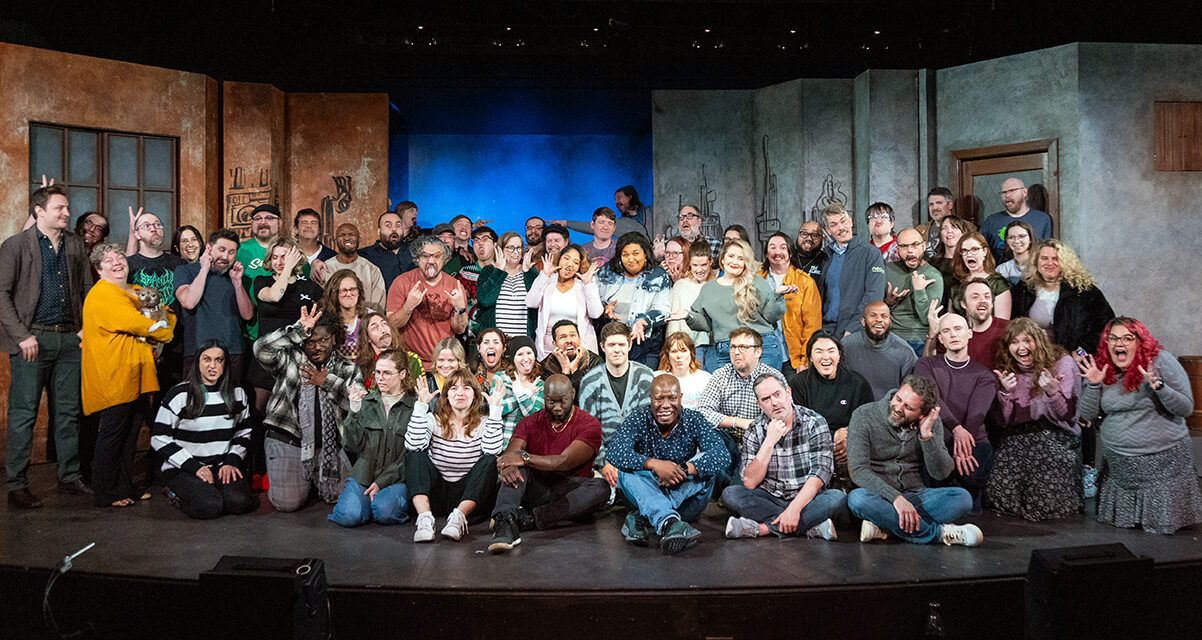
For 30 years, Dad’s Garage Theatre has been a comedic mainstay in Atlanta’s arts scene. Founded in 1995 by a group of recent Florida State grads, the nonprofit troupe quickly made a name for itself with its unfiltered, offbeat approach to improv, sketch, and original scripted performances. Nestled in the heart of the Old Fourth Ward, Dad’s Garage isn’t your average black box theater. It’s a hub of artistic chaos and creative risk-taking, built on the philosophy of saying “Yes, and…” to bold ideas and emerging voices.
With over 400 shows a year, a loyal fanbase, and deep roots in Atlanta’s creative culture, Dad’s Garage has become both a launch pad for national talent and a magnet for audiences hungry for something unpredictable. You may have seen their alumni on Archer, Aqua Teen Hunger Force, or Too Many Cooks, but the real magic still happens onstage at their Ezzard Street home, where improv is king and no two nights are ever the same.
We caught up with Lily Stancill, the theater’s marketing manager, to talk about the evolution of Southern comedy, the joys and pitfalls of improv, and what makes Dad’s Garage a force of comedic nature.
Q: Tell me a little about the history of the troupe. How did you end up putting roots down in Atlanta?
A: Dad’s Garage was the dream of a starry-eyed group of FSU grads in 1995 after witnessing an improv show by happenstance while they were in school. They chose to create the theatre in Atlanta in part due to the economic boom from the Olympics and because Atlanta struck them as a unique place to live and perform. So long as the show is funny and fresh, Dad’s Garage tackled it with aplomb. Eventually, the theatre gained the reputation of the “bad boys and girls” of the Atlanta theatre scene, and then transitioned to a staple of the national improv scene. Dad’s Garage offered something other theaters in the South largely did not: unabashed uniqueness and unrestrained humor. While Dad’s Garage improv is its most well-known offering and a constant presence, the theatre’s scripted work (most of which is original!) reinforced the reputation tenfold. They gleefully run the gamut of unbelievable, spectacular, gross, uncensored, irreverent, goofy, and sometimes even affably pretentious—maybe even all at the same time. Song of the Living Dead, Black Nerd, Scarlet’s Web, Woman of the Year, Wrath of Con, Invasion: Christmas Carol, Murder on Vavianna Island… these shows span the Dad’s Garage timeline for scripted and sketch work, but they are undeniably unforgettable and not the type of productions common to most theaters in the South.
Q: How has the Atlanta comedy scene changed since Dad’s Garage started?
A: Dad’s Garage is 30 years old as of August 2025, so remembering a time before is difficult for many. Remembering a time before the 2020 pandemic is also difficult for many! However, most comedy venues in Atlanta today emphasize stand-up or music acts. Some are a healthy mix of stand-up, improv, and variety, but in recent years, Dad’s Garage’s predominantly improv and scripted mix is becoming more and more unique.
Q: How do Atlanta and Southern comedy audiences compare to other cities? Any unique challenges or advantages to performing here?
A: Atlanta is a completely different audience than, say, New York or Chicago in part because the city does not have as established and widespread of a theatre culture as other comparable North American hubs (not to point fingers, but Georgia in particular is one of the least-funded states for arts and culture. That could have something to do with it. Dad’s Garage is a nonprofit—donate today!) The predominant theatre culture here is generally more formal and keeps a similarly rigid fourth wall in place between the performers onstage and the audience, but the improv scene—especially at Dad’s Garage—keeps that wall much thinner, more tactile, and allows performances to be more in-your-face.
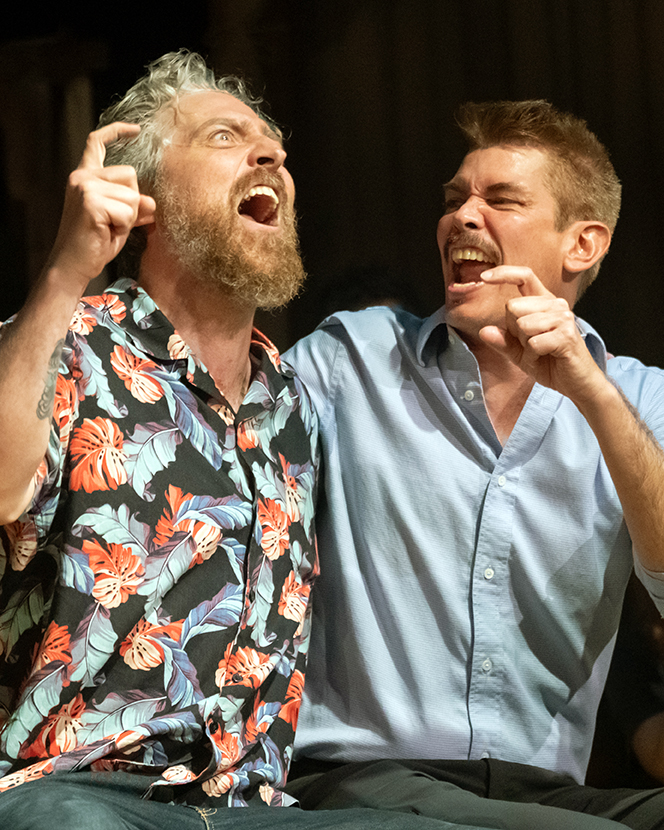
Kevin Gillese and George Faughnan. Photo by Casey Gardner Ford
Q: Does the South’s long tradition of storytelling naturally blend with improv? Or is it more of a challenge to reconcile the two?
A: It’s a perfect fit, especially at Dad’s Garage. Narrative is the bread and butter of most improv formats and games and it is a particular point of import at Dad’s Garage. Armando, Death Box, Forward/Reverse, Harold, Tap-out monologue… I could continue listing some of the most common long- and short-forms used here, but that’s not very informative. Every performer here has a knack for telling stories, and all of them will add their own color to the narrative even when they pass the baton to another improviser.
Q: What’s something most audiences don’t realize about what it takes to keep an improv show afloat?
A: Improv shows may not require memorization, but they require constant focus. Flexibility is key, and it is crucial for a performer to be prepared to let a character motive change fluidly based on the offers given by other performers. The best improvisers are not necessarily the ones with the best one-liners or physical comedy, but the ones that can turn on a dime to support a scene, gracefully receive and provide offers. It takes a lot of concentration to transition from performing as, say, an elephant with a bad haircut to a strait-laced tax attorney while keeping the scene cohesive!
Q: What’s something utterly unglamorous about improv that people wouldn’t guess?
A: There is no telling what a drunk patron will do in the theatre. The rules and atmosphere at a comedy improv venue are very different than a more formal theatre, and it isn’t always a good thing.
Q: Do you thinkWhose Line Is It Anyway? helped audiences better understand improv? Or does it give people the wrong impression?
A: We love Whose Line! The show proved formative for much of our audience and our performers, and the easy lead-in the show offers to explaining what an improv performance is like to a new audience member is a major boon for us. In fact, Colin Mochrie is a friend of Dad’s Garage and visits us about once a year for special performances. The show’s ubiquity is especially helpful when explaining TheatreSports to new audience members. Usually, if an audience member has a good grasp of Whose Line, they catch onto the differences in TheatreSports once they see it in practice.
It’s much more effective than explaining the concept to them outside of the show’s introduction, and we feel confident that they’ll enjoy TheatreSports and improv in general if they like Whose Line. As it happens, Dad’s Garage TheatreSports is unique to other TheatreSports—the International TheatreSports Institute is an improv network of theaters licensed to do TheatreSports, but every theatre does it a little differently. In World Domination TheatreSports Tournaments past where other theaters came to compete in TheatreSports against the Dad’s Garage ensemble, the differences helped make it exciting.
Q: Traditionally, Southern humor has had a reputation for a certain tone. People don’t usually associate “Southern humor” with improv. Are you working to change that perception?
A: We absolutely want the Southeast—sorry, I’m talking in terms of marketing regions, but by this I absolutely mean the South—to be a dominating player in comedy improv, and of course we want Dad’s Garage to be the destination! We believe in the larger improv community here, too, but it would be ridiculous to deny that we endeavor to be the best of them all. Many of our ensemble and associated performers are Southerners (and it shows in their performance), but many hail from Chicago, Wisconsin, California, etc. The unifying identity is their Dad’s Garage training and its underlying philosophy. On a fundamental level, Dad’s Garage improv follows the philosophy of Keith Johnstone (who is definitely NOT from the South), but it’s an undeniable fact that Dad’s Garage improv and training is distinct from that of other places. So yes, even with that minutiae out of the way, there’s still something to be said about the specific flavor of Dad’s Garage comedy and how, from the perspective of out-of-towners, it is quintessentially Eastside Atlanta and Southern.
Q: Are there topics that tend to work better—or worse—here than in other places, like Portland or New York?
A: Yes—and understanding what the local audience prefers can be as mystifying as it is informative when introducing new shows to the world. Many of Dad’s Garage’s sketch shows emphasize regional topics and idiosyncrasies, so while they would still be funny in other places, they were designed for metro Atlanta first and foremost.
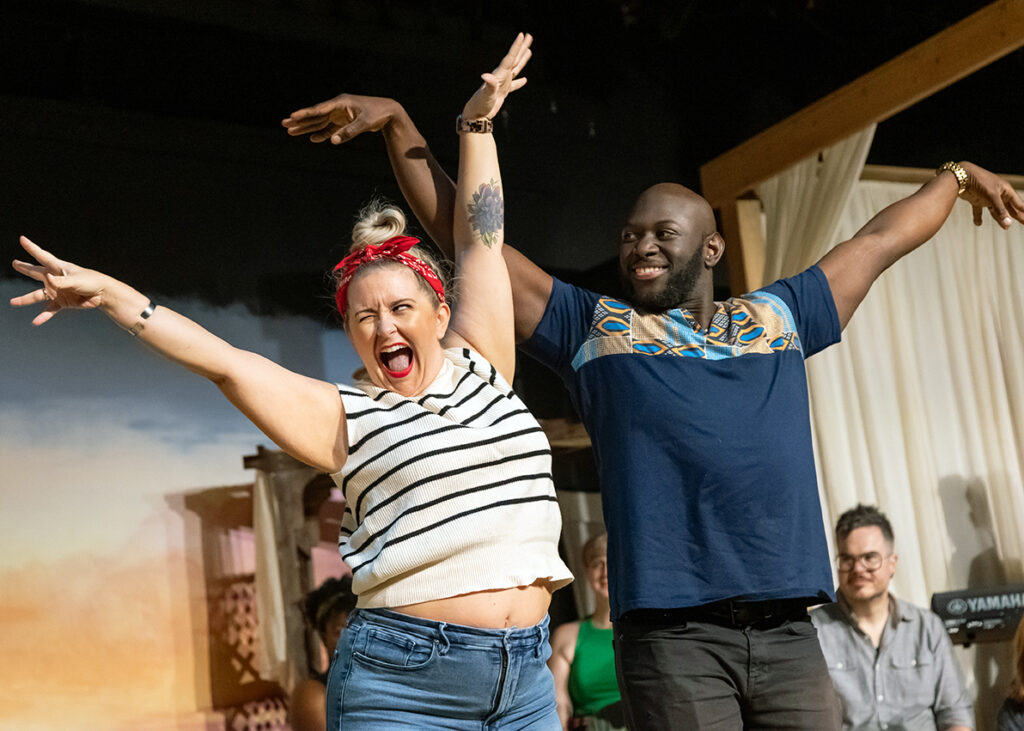
Whittney Millsap Nowacki, Avery Sharpe-Steele and Travis Sharp. Photo by Casey Gardner Ford
Q: Does the company travel often? Or do most performances stay grounded in Atlanta?
A: Dad’s Garage does not have a formal travel company, but we love to perform in other places locally, regionally, and internationally. Members of the ensemble frequently travel to Edmonton for the Fringe Festival, for example, but the sky is the limit. This November, the ensemble traveled to New York for a reading of Invasion: Christmas Carol! While we do have troupes (BlackGround—they went to New York in 2024 and will likely perform there again) and unofficial teams (Ed, Tom, and Rueben come to mind) that began at the theatre and are made from the ensemble’s members, cast assignments tend to be fluid. Any two or more ensemble members can perform together or on tour and put on an incredible show! We love to go places.
Q: If someone starts from scratch and takes an improv class at Dad’s Garage, how long does it typically take before they’re performing with the troupe? Does it happen often?
A: It happens. The full improv course of levels 1–5 offered at Dad’s Garage takes approximately 10 months to complete, and the capstone Conservatory program lasts one year. After that, performers are eligible to be voted into the ensemble. However, strong performers at the higher levels of the course—or with comparable improv training at another recognized improv theatre—can perform alongside the ensemble members occasionally. While ensemble members have priority for shows, most improv shows at the theatre usually do not unilaterally restrict non-ensemble from performing, too.
Q: What’s something an audience might see at Dad’s Garage that they wouldn’t see at any other improv troupe?
A: I can think of many individual examples, but the strength of improv is its ability to be totally unpredictable. Dad’s Garage is extra unpredictable. But perhaps the most special—and repeated—feedback audiences give is their disbelief that what the ensemble creates onstage during an improv show isn’t scripted. Invasion: Christmas Carol is the theatre’s best showcase of this sensation, but a Dad’s Garage TheatreSports is capable of magic, too.
Q: What’s your long-term goal for keeping improv comedy alive in Atlanta?
A: We’re the best, we’re going to keep being the best, and we believe that Atlanta is the future hub of improv comedy!
(Dad’s Garage 2024 cast photo by Casey Gardner Ford)


Recent Comments