
Every year, the same question pops up at cocktail parties, dinner tables and political gatherings: why aren’t there more funny conservatives? The implication, of course, is that conservatives simply lack a sense of humor. They’re too buttoned-up and serious-minded to ever really “get” comedy.
But the reality is more complicated than that.
There’s a long and storied history of comedians with conservative instincts or audiences. America once adored Will Rogers, the rope-twirling Oklahoma cowboy who made a national pastime out of poking fun at politicians. Mark Twain built an entire career roasting hypocrisy, greed, religion, and occasionally the human race itself.
Today, comics such as Nick Di Paolo, Dennis Miller, Tim Dillon, Joe Rogan, and Henry Cho have all built large audiences that lean to the right. Clearly, conservatives can be funny. So what gives?
Comedy Thrives on Friction
Comedy almost always grows where there is tension.
It thrives in places where people feel squeezed by absurd rules, strange institutions, or powerful authorities who seem to take themselves far too seriously. The friction between everyday life and the systems that govern it provides rich comedy material.
This is why so many influential comedians historically emerged from the margins of society. Jewish comedians helped shape twentieth-century American stand-up. Black comedians transformed injustice into some of the sharpest observational humor ever written. Immigrant comics and LGBTQ performers often build routines around cultural contradictions and institutional absurdities.
Being on the outside provides an abundance of targets. When someone is far from power, there is always something above them to poke. Power changes that dynamic.
Punch down at the powerless, and the laughter feels mean-spirited and cruel. Defend the establishment, and your jokes begin sounding more like tedious lectures, the death knell of any successful comedy routine.
Why Outsiders Get the Joke First
There’s also a deeper psychological element at play.
Outsiders often become expert observers of the dominant culture. When you exist slightly outside the center of power, you start noticing the unfair rules, the small hypocrisies, and the strange social rituals that insiders take for granted.
That critical distance is the seed of strong comedy. Stand-up comedians are essentially professional observers. Their job is to stand slightly apart from the room and say, “Does anyone else find this ridiculous?”
People who have lived on the margins have been practicing that skill their entire lives. When you’re the one making the rules, that perspective becomes much harder to maintain.
The Rules of Power Humor
None of this means powerful people can’t be funny. History shows that they absolutely can. They just need to follow a few different rules.
Mock Yourself First
The first rule of power humor is simple: become the joke before anyone else does.
Ronald Reagan demonstrated this instinctively during the 1984 presidential debates, when concerns about his age were swirling. Reagan waved it away with a single line:
“I will not exploit, for political purposes, my opponent’s youth and inexperience.”
The audience erupted.
The joke worked because Reagan targeted himself first, but it was a double jab. He hit his opponent while simultaneously hitting himself. There was no defense. Showing you can laugh at yourself immediately disarms the audience and gives you permission to tease others.
Self-mockery buys credibility. Twain understood it. Rogers perfected it. The audience senses that the comedian is part of the joke rather than on a pedestal above it.
Punch Sideways, Not Down
Audiences instinctively recoil when someone powerful mocks people beneath them—the handicapped, the poor, the powerless. But they’re perfectly happy watching powerful people mock each other.
Political roasts always work because the humor feels like friendly sparring between equals rather than cruelty directed downward.
Find the Irritations Everyone Shares
When punching upward isn’t available, comedians often rely on another reliable target: shared annoyance.
Some of the most successful comedians in America have built entire careers around the things that irritate everyone: airline travel, bureaucracy, confusing technology, awkward social behavior, and the endless parade of people doing incredibly obvious things wrong.
The comedians of the Blue Collar Comedy Tour made a national sensation out of this approach. Their routines often targeted foolish behavior rather than specific groups. Bill Engvall’s famous “Here’s your sign” bit worked because everyone in the audience had encountered someone who deserved one.
The target wasn’t a group of people. The target was behavior everyone recognizes as ridiculous. Nothing bonds an audience faster than shared irritation.
When Power Played Along
For decades, one place where this balance worked beautifully was the White House Correspondents’ Dinner.
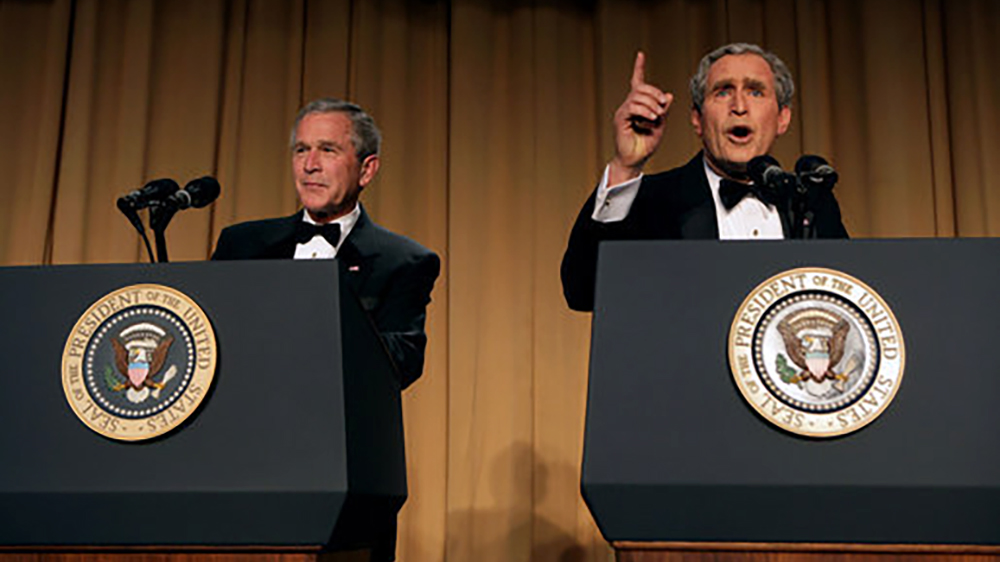
Presidents from both parties allowed themselves to be roasted in front of journalists, comedians, and political rivals. Leaders like George W. Bush and Barack Obama often leaned into the moment, delivering surprisingly sharp self-deprecating jokes of their own.
The ritual worked because everyone agreed to the same rule: the powerful were willing to laugh at themselves.
Political figures on the left have long been targets as well. Lyndon B. Johnson’s towering personality made him a natural subject for satire in his era, and Bill Clinton’s scandals fueled late-night punchlines throughout the 1990s.
But in more recent years, that tradition has begun to fade. Donald Trump has declined to attend the dinner during his presidency, reflecting a broader political culture that has grown far less comfortable with self-mockery.
A More Serious Political Era
More broadly, modern politics has become increasingly allergic to humor.
In an environment where every comment can become a viral controversy within minutes, public figures often choose defensiveness over playfulness. The result is a political culture where leaders are less willing to laugh at themselves, and far quicker to take offense.
Comedy struggles in that kind of atmosphere because humor requires something politics increasingly discourages: humility.
Humor Requires Humility
At its core, comedy works best when the comedian stands beside the audience rather than above it. People laugh when they feel like they’re all participating in the same absurd situation together.
Which brings us back to that original question about conservative comedy. Perhaps the issue isn’t ideology at all. Perhaps the real challenge is that humor becomes harder the moment anyone starts taking themselves too seriously. Power tends to encourage seriousness. Comedy depends on the opposite.
Power and the powerful can absolutely be funny. But it only works when the powerful remember one simple rule: before you make fun of the world, you have to show the audience you’re willing to be part of the absurdity too. Otherwise you’re not telling jokes. You’re just spouting stuffy, political words.
History has shown that the powerful can absolutely be funny.
They just have to get out of their own way.
[President George W. Bush and Steve Bridges at 2006 White House Correspondents Dinner. White House photo by Kimberlee Hewitt]

Like what we do? Subscribe for contemporary Southern humor delivered to you.




Recent Comments