From the time I am fifteen years of age until I am nineteen, I am the greatest actor on the planet. I have this on the authority of the engraved plates of several statuettes I receive during these years, and also on the authority of my mother, who—bless her memory—is in no way biased. This head-spinning success spans my last two years at Scott County High School in Kentucky and my first two years of college at a tiny Baptist college in Tennessee.
Back in Kentucky on Christmas break, I run into a friend who is basically my female equivalent on the talent spectrum during our high school years. I assume she has landed every lead role at her chosen college just as I have at mine, and am surprised when she rolls her eyes at this assumption. She attends a “university” rather than a small Baptist college and is lucky, she professes, to be cast in even student-led productions. And whereas the college which I bestride like a colossus has SIX individuals majoring in theatre, her university boasts over 200 theatre AND DANCE majors! She herself has taken classes in ballet and jazz and TAP!
I am gobsmacked! 200 MAJORS?!! And…DANCE? Unknown even to myself until this moment, there is a genetic duplicate of Gene Kelly limbering up in the coils of my DNA. This individual—sporting his cocked fedora—lunges up into my throat, twirling his wide-open umbrella, and I can barely breathe. What have I been DOING with my life?!!! I have the statuettes to prove I have conquered the institution of higher learning I currently attend! I am desperate for a challenge!! And with a transfer to a university which offers dance classes, my success as the second coming of Gene Kelly will be virtually assured!
I immediately apply to transfer from college to a university, and my application is accepted.
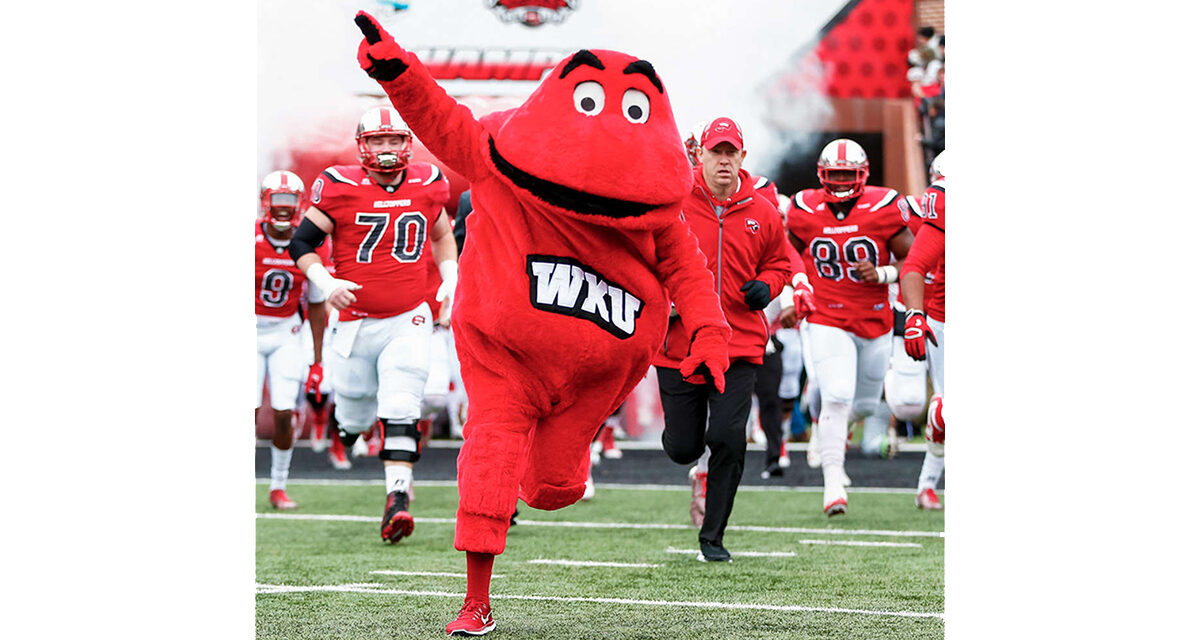
The following fall I arrive in Bowling Green, Kentucky, at Western Kentucky University—home of the Western Kentucky University Hilltoppers. A “Hilltopper,” for those of you unacquainted with such, could easily be the first cousin of the McDonald’s “Grimace.” “Big Red” is basically an enormous blood clot with eyes and arms and legs and a mouth that sags open—unable to close even at the behest of its owner. For my freshman and sophomore years I am a Carson-Newman Eagle. I am now a Western Kentucky University Hilltopper.
And it is at WKU in Bowling Green I find out my acting ability—based largely on funny voices and dialects and stooping slightly to walk as an “old man” (I am, perhaps, the only person of any gender to play the role of Martin “Grandpa” Vanderhoff in You Can’t Take It With You TWICE—once in high school and once in college—before I turned 18)—is better suited to the building of scenery and the construction of props.
I turn nineteen that November and am no longer the greatest actor on the face of the planet.
But two years later I do graduate from Western Kentucky University in Bowling Green. Years pass, and while these years take me many places, thirteen years later I am back in Kentucky and planning a move to New York City.
Note: When I am a snot-nosed seventeen-year-old starring in my high school productions, I vow with certainty I will never—even if dragged by Arabian stallions—live in New York City. Because I know from television and stand-up comedy that New York City is a hellhole of sin and debauchery and violence so prolific as to render the Hatfields and McCoys angelic by comparison. As if in testament to this fact, later that year is released a popular song by Queen in which Freddie growls, “out of the subway, the bullets RIP to the sound of the beat…!” The fact that the lyric is actually “out of the DOORWAY the bullets rip,” is beside the point. In my mind, the bullets are ripping out of the side of a garishly graffitied subway car, tearing great gashes in its metal sides. I will never deign to live there, no matter how brightly Broadway glitters.
And then—in Louisville, KY—I fall in love with an actress who wants to move back to New York City, and that’s that.
Now in New York City there are many places to go, and the names of many serve as much as landmarks as anything else: nicknamed neighborhoods like “Bed-Stuy,” “Dumbo,” and “Little India”; museums, zoos, and hundreds of parks; transit hubs like “Grand Central” and “Port Authority”; the flower district; the garment district; not to mention the Empire State Building, the Chrysler Building, the Flatiron Building.
And there are historic sites and place names as well.
One of these is Bowling Green.
Bowling Green, Kentucky. Bowling Green, NYC. Could there be a connection?
Could be.
New York’s Bowling Green is established as the city’s first public park in 1733, with the provision that it is kept by the British residents in suitable shape for such pastimes as “lawn bowles”—probably the same “ninepins” as provides rumbling peals of thunder when played by the little men of Hudson’s crew in Rip Van Winkle.
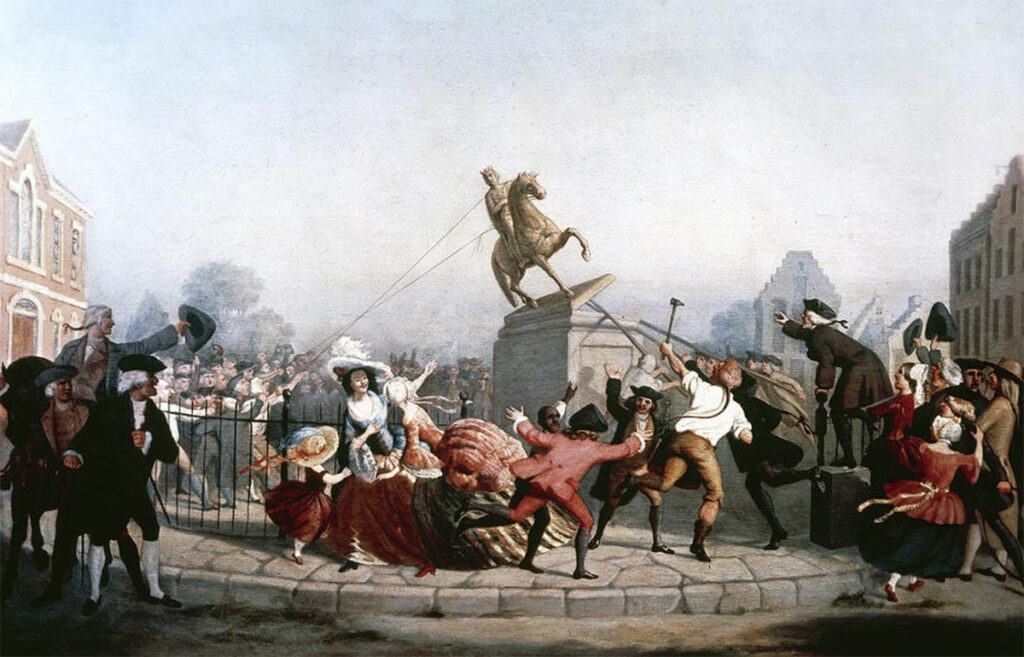
Then, in 1776, after a public reading of the Declaration of Independence, a lead statue of King George III—which presides over Bowling Green for six years—is exultantly pulled down by a sizable crowd of not-yet-but-soon-to-be U.S. citizens, and melted into musket balls to arm George Washington’s Continental Army.
And it is this demonstration of Revolutionary spirit the founders have in mind when, in 1798—900 miles west and south of that historic park—they decide to bestow the honorific “Bowling Green” to a newly established Kentucky town, which is now—in 2026—the third-largest city in the state.
And that young actor who attends WKU but vows he will never live in NYC despite the glittering enticements of the Great White Way? He now lives in Manhattan, where the southernmost point (and beginning) of Broadway is…Bowling Green.
[Western Kentucky University mascot, “Big Red,” photo by Ralphcar. Photo licensed under the Creative Commons Attribution-Share Alike 4.0 International license.
”Pulling Down the Statue of George III”, oil painting by William Walcutt (1819-1882), circa 1854. Public Domain]