
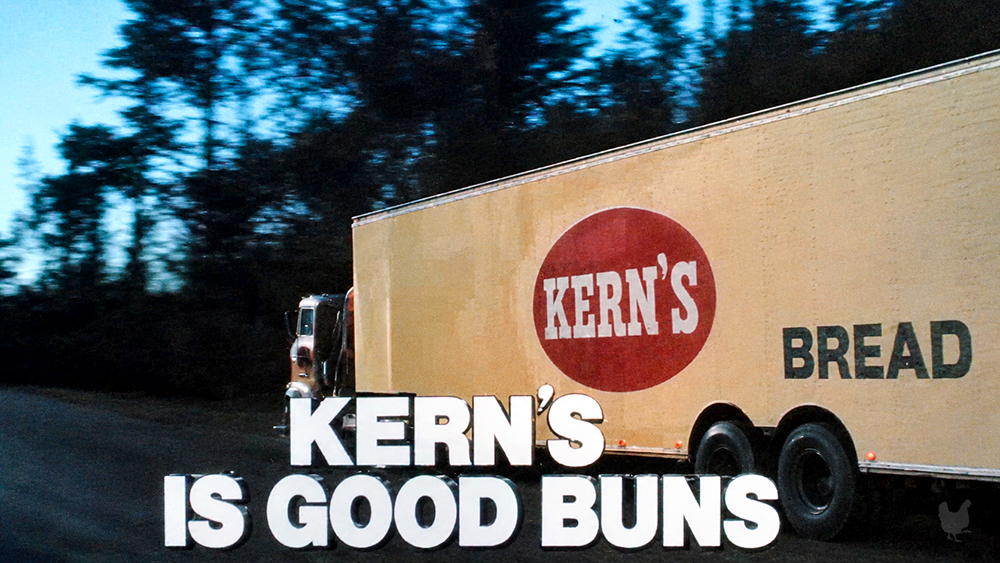
If you grew up in East Tennessee during the 1970s, you remember the names A.J. Tucker and Mavis the way you remember Fonzie and Vinnie Barbarino.
If you didn’t, those names won’t mean much. That’s understandable. A.J. Tucker never had a hit record. He never starred in a television series. The fact is, A.J. Tucker never really existed. He was the fictional truck driver at the center of a series of Kern’s Bread commercials that aired throughout East Tennessee. Alongside Mavis, the cute and flirty waitress at a roadside café called the Mama Kern’s Fill-er-Up An’ Keep On A-Truckin’ Café, A.J. became a familiar presence in our homes.
The commercials were funny, folksy, fast-paced, and well written. Kids sang the songs at school. Adults talked about them at work. They felt less like bread ads and more like thirty-second episodes of a lost Andy Griffith Show spinoff that may have gotten a little too steamy for Mayberry.
As a kid, I wondered whether A.J. was a real trucker. Later, I simply assumed the commercials were a clever local advertising campaign. Then I started digging into their history. Like many good stories, this one gets more interesting the deeper you go.
The bread commercials weren’t originally created for Tennessee. They began several states away as a campaign for the Old Home Bread Company. In those original commercials, the truck driver wasn’t named A.J. Tucker.
He was C.W. McCall.
Mavis was still there, but watching the Old Home commercials—with many of the same storylines, characters, and jokes but different names and products—is a little like discovering your spouse has been married to someone else all along and living a secret life.
The ad campaign was created by Omaha advertising executive William Dale Fries, Jr. and his creative partner, Chip Davis. Fries wrote and narrated the spots, while Dallas actor Jim Finlayson played the truck driver on screen. Actress Jean McBride Capps portrayed Mavis, the quick-witted waitress who was always ready with a comeback, a fresh cup of coffee, and a Marilyn Monroe wink.
When the campaign was adapted for Kern’s Bread in East Tennessee, the name C.W. McCall became A.J. Tucker. Most of us never knew there had been another version. As far as we were concerned, A.J. belonged to East Tennessee.
What made the commercials memorable wasn’t the bread. It was the characters. There was something recognizable about the little world they inhabited. A.J. wasn’t portrayed as a buffoon, and Mavis wasn’t simply a pretty face behind a counter. Their conversations had an effortless chemistry, and the humor came from their personalities rather than exaggerated Southern stereotypes.
Before long, viewers were invested in the A.J. and Mavis storyline. We learned that A.J. had a dog named Sloan. We met Mavis’s mother, who sometimes chaperoned their dates. Their romance became a soap opera wrapped tightly into half a minute, like a tiny Kern’s fried apple pie.
That may be why the campaign translated so well to East Tennessee. Whether the writers intended it or not, they captured something familiar: truck stops, diners, country roads, and working people who seemed to recognize a kinship in one another before they even exchanged names.
The music rang true to the region as well. Fries’s baritone narration over country steel guitar sounded like something you might hear on a Saturday night at the Village Barn. It felt as natural coming through the television as anything playing on WIVK.
Eventually, Fries wondered whether the commercials might work as actual radio songs. Borrowing the name C.W. McCall from his truck-driving character, he began recording country songs built around the same kind of storytelling that had made the bread commercials so popular. One song in particular struck a nerve.
Released in 1975, Convoy became a number-one hit. Built around CB radio banter and the adventures of a group of rebellious truck drivers, it arrived just as America was falling in love with CB culture. Suddenly, everyone wanted a handle. CB radios flew off store shelves. Trucker slang entered everyday conversation. A few years later, Convoy inspired a major motion picture directed by Sam Peckinpah and starring Kris Kristofferson.
Mavis would have been proud.
It’s difficult to think of another advertising campaign that wandered so far into American pop culture. But the irony doesn’t stop there.
Chip Davis, Fries’s creative partner, reportedly wasn’t much of a country music fan. After helping create C.W. McCall and Convoy, he went on to create Mannheim Steamroller, eventually becoming one of the most recognizable names in modern Christmas music.
Meanwhile, William Fries spent years performing as C.W. McCall, the truck driver he had invented to sell bread. None of this was remotely obvious to those of us watching Kern’s Bread commercials after school in Knoxville.
We weren’t thinking about Omaha advertising agencies, Clio Awards, or Billboard charts. We were watching A.J. Tucker pull into Mavis’s café, trade flirty jokes over coffee, and climb back into his rig. The bread was almost incidental. That may be the highest compliment an advertising campaign can receive: people remembered the story long after they forgot what it was selling. Today, most advertising is designed to grab our attention for a few seconds before disappearing into the next video or social media feed. It is fast, disposable, and forgotten almost immediately.
The A.J. Tucker commercials were different. They created a little world viewers wanted to revisit. In doing so, they set off a chain of events that produced one of the biggest songs of the 1970s, a Hollywood movie, and a national pop culture phenomenon that began, improbably enough, with a loaf of bread.
For those of us who grew up in East Tennessee, A.J. Tucker and Mavis are more than characters from old television commercials. They are a small piece of regional history worth preserving. Not because they changed the world, but because they remind us of a time when local culture had room to develop its own characters, stories, and shared experiences.
Even though A.J. Tucker and Mavis never existed, fifty years later, thousands of East Tennesseans still remember them as if they did.